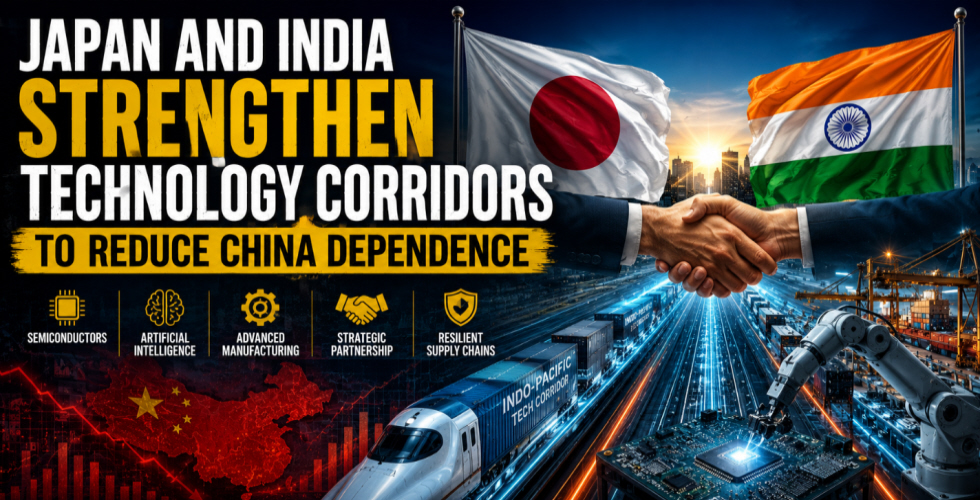
Japan and India are accelerating efforts to strengthen technological and industrial corridors as part of a broader strategy aimed at reducing dependence on Chinese supply chains. The growing cooperation reflects increasing geopolitical concerns over global manufacturing concentration and economic vulnerability. Both nations are positioning themselves as key players in the future of advanced technology production. The partnership focuses heavily on semiconductors, artificial intelligence, telecommunications and advanced manufacturing infrastructure.
Officials from both countries believe stronger regional cooperation could help create more resilient supply networks capable of competing with China’s massive industrial dominance. The initiative also aligns with broader Indo-Pacific strategic objectives supported by several Western economies. For years, China has maintained overwhelming influence over critical manufacturing sectors, including electronics, batteries and industrial components. However, rising geopolitical tensions and fears of supply disruptions have encouraged multiple countries to diversify production chains.
Japan and India now see an opportunity to emerge as alternative technological hubs for international investors. Japan brings decades of technological expertise, industrial precision and strong research capabilities to the partnership. India, meanwhile, offers a rapidly expanding workforce, growing infrastructure and one of the world’s largest consumer markets. Together, both countries hope to create a strategic economic corridor capable of attracting large-scale foreign investment. The cooperation also carries major geopolitical implications beyond economics alone.
Analysts believe Tokyo and New Delhi are attempting to strengthen regional influence while balancing China’s growing economic and military presence across Asia. The technology sector increasingly became a central battleground in the broader competition for global strategic leadership. Several multinational corporations have already started evaluating expansion opportunities within India and Japan as governments introduce incentives for technology manufacturing. Semiconductor production facilities, battery plants and AI research centers are among the industries receiving increased political and financial support.
Investors are closely monitoring the speed and stability of these new regional partnerships. Energy security and critical minerals are also part of the long-term strategic calculations. Both countries understand that future technological competitiveness will depend heavily on access to rare earth minerals, advanced batteries and reliable energy infrastructure. Reducing excessive dependence on any single supplier became a growing priority after recent global disruptions exposed vulnerabilities in international trade systems. The initiative may also reshape trade dynamics throughout the Indo-Pacific region.
By creating alternative manufacturing and logistics networks, Japan and India hope to strengthen regional economic integration while increasing resilience against future geopolitical tensions. Some experts describe the project as part of a larger movement toward a more fragmented but strategically diversified global economy. China continues defending its position as the world’s leading industrial powerhouse and remains deeply integrated into global manufacturing systems.
However, Beijing is closely observing efforts by neighboring countries to reduce strategic dependence on Chinese production. The situation reflects a broader global trend where economics, technology and geopolitics are becoming increasingly interconnected. The growing partnership between Japan and India signals that the global competition for technological leadership is entering a new phase.
As nations seek stronger control over supply chains, semiconductors and advanced industries, Asia may become the center of an increasingly complex economic realignment. The outcome could influence global markets, investments and geopolitical alliances for decades ahead.

