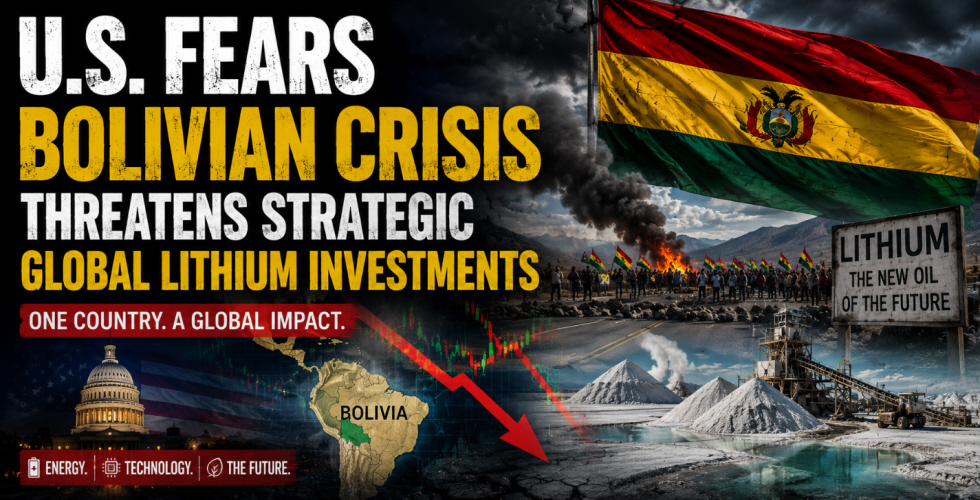
The growing social and political crisis in Bolivia has begun raising international concern due to its potential impact on future strategic lithium investments. Analysts and financial sectors believe the instability could affect key projects linked to one of the world’s most important mineral resources for the global energy transition. Governments and international markets are already monitoring the situation closely. In United States, concerns are growing that Bolivia’s internal conflict could delay investments aimed at strengthening global technological supply chains.
Lithium has become a critical resource for electric batteries, energy storage systems and emerging industries connected to artificial intelligence and sustainable transportation. Washington is carefully watching any scenario that could threaten future access to these strategic minerals. Bolivia possesses one of the largest lithium reserves on the planet, particularly in the Salar de Uyuni, considered one of the world’s most valuable mineral territories. For years, different governments attempted to transform the country into a regional energy power through lithium development. However, political tensions, infrastructure limitations and internal conflicts slowed several strategic projects.
The current wave of protests and road blockades is once again raising doubts about the stability required to attract major international investment. Foreign companies generally demand legal certainty, institutional continuity and reliable logistical conditions before committing billions of dollars to long-term projects. Political uncertainty can rapidly become a major financial risk factor. As highways remain partially blocked and social tensions intensify, several economic sectors warn about possible consequences for Bolivia’s international image.
International investors are cautiously monitoring any sign of prolonged instability, particularly in regions connected to strategic resource development projects. The primary concern is that Bolivia could lose competitiveness against other global producers. The situation is also generating geopolitical interest due to growing competition between United States and China to secure access to critical minerals needed for future industries. Lithium is currently considered essential for electric vehicle expansion, advanced military technology and modern energy systems. Latin America has increasingly become a strategic territory within this silent global competition.
International specialists argue that political stability will play a decisive role in determining which nations dominate the technological energy market over the coming decades. In that context, Bolivia appears as a country with enormous potential but also significant institutional vulnerability. Repeated social conflicts continue raising doubts about the nation’s ability to consolidate sustainable industrial projects. The Bolivian government insists that natural resources must primarily benefit the national population and continues defending stronger state participation in future energy projects.
However, business sectors warn that without economic stability and clear regulations, attracting sufficient foreign capital to fully develop the lithium industry will remain extremely difficult. The debate continues deepening internal divisions. Meanwhile, ongoing protests continue reflecting strong public frustration over fuel shortages, inflation and years of accumulated political tensions. For many citizens, the current conflict goes far beyond mining development and instead represents a broader struggle over the country’s economic and political future.
Many Bolivians fear the crisis will continue damaging living conditions and increasing national uncertainty. Bolivia’s immediate future will depend not only on resolving the current blockades, but also on building an institutional environment capable of generating both domestic and international confidence. The world is watching carefully because lithium is no longer simply a regional resource — it has become a strategic pillar of the modern global economy. What happens in Bolivia could ultimately influence far more than its own borders.