
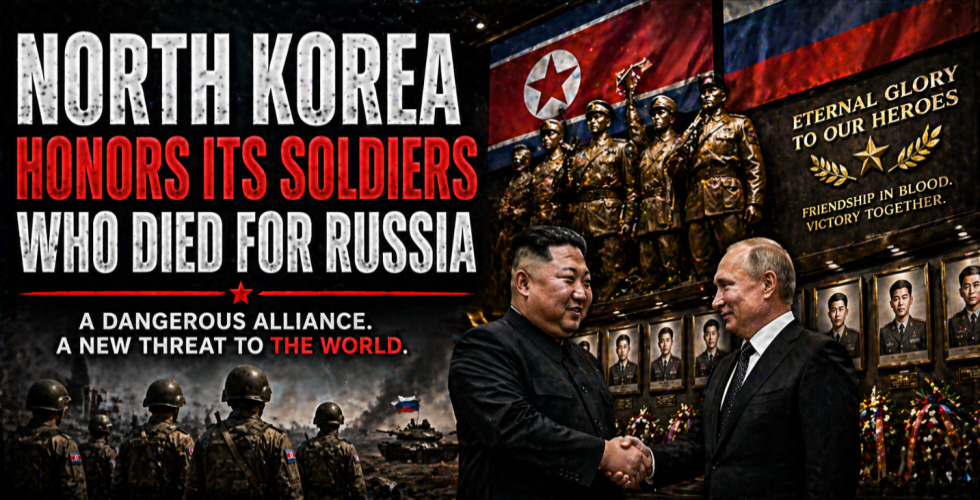
North Korea continues to deepen its military alliance with Russia in one of the most delicate geopolitical moves of the war in Ukraine. Pyongyang has not only sent troops to support operations in sensitive areas such as Kursk, but also technicians, specialized workers, and military supplies that strengthen Russia’s operational capacity. The cooperation is no longer symbolic, but structural and strategic. Various international reports indicate that new North Korean contingents could include tens of thousands of additional soldiers, along with personnel linked to military infrastructure construction and drone-related production.
Although the exact figures have not been officially confirmed by Moscow or Pyongyang, the overall trend points to an increasingly deep participation in Russia’s war effort. The Kursk region has become one of the main centers of that cooperation. There, North Korean troops are believed to have participated in joint operations to contain Ukrainian incursions and reinforce strategic border positions. The experience gained in real combat represents enormous value for Kim Jong Un’s army, which for decades has operated without direct exposure to large-scale modern warfare.
In addition to military deployment, North Korea is also providing ammunition, missiles, and logistical support that help sustain Russian pressure on the Ukrainian front. Russia needs constant human and material resources to maintain the intensity of the conflict, and Pyongyang appears as an ally willing to assume that international political cost. The relationship between both governments has become much more visible. But this exchange does not happen for free. In return for troops, labor, and military support, North Korea is believed to be receiving economic assistance, food, fuel, and above all, access to advanced military technology.
Western analysts fear that Moscow may be transferring sensitive knowledge in air defense, missile systems, satellites, and even electronic warfare capabilities. That possible technological access deeply concerns South Korea, Japan, and the United States. The military strengthening of Pyongyang affects not only the European battlefield, but also the strategic balance in East Asia. Every improvement in air defense or missile precision can alter the regional security calculation around the Korean Peninsula.
Kim Jong Un presents this alliance as a sign of resistance against the Western bloc and as proof that North Korea is not internationally isolated. Vladimir Putin, for his part, finds in Pyongyang a useful partner that does not impose Western political conditions and can provide resources during moments of maximum international pressure. Both governments benefit from a logic of shared survival.
Beyond the exact numbers, what truly matters is that the relationship between Russia and North Korea has entered a new phase of open military integration. This is no longer only about diplomatic support or limited trade, but about soldiers, technology, and real operational commitments. This alliance could redefine not only the conflict in Ukraine, but also the future balance of power between Europe and Asia.


