
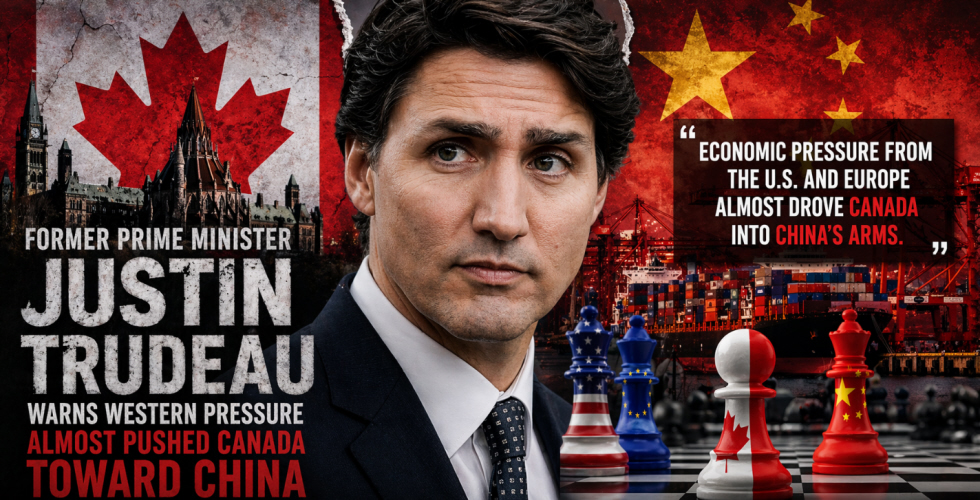
Former Canadian Prime Minister Justin Trudeau’s recent remarks have reignited debate over the geopolitical balance between the West and China. During a public appearance, Trudeau stated that economic pressure from the United States and Europe nearly pushed Canada toward greater strategic dependence on Beijing. His words immediately drew attention due to the fragile international climate. The relationship between traditional allies is once again under serious analysis. According to Trudeau, one of the most sensitive moments occurred during intense competition in the aerospace sector, when Canada faced strong commercial pressure and restrictions from its own Western partners.
That situation may have opened the door to closer economic ties with China as an alternative. His statement exposes an uncomfortable reality about the fragility of certain alliances. Economics often reshapes diplomacy. Canada has historically maintained a close relationship with Washington and strong economic integration with the United States. However, in times of high global competition, even the strongest allies face tensions when industrial interests collide. Trudeau suggested that during that period, Ottawa had to consider options outside its usual strategic circle. External pressure forced a reassessment of national priorities.
China, for its part, has spent years expanding its influence in North America through investment, trade, and technological cooperation. Although relations between Ottawa and Beijing have also gone through difficult moments, the Asian giant remains a power that cannot be ignored. In that strategic landscape, every move carries global consequences. Economic diplomacy becomes a silent instrument of power. The remarks also reflect indirect criticism of how the West manages its internal relationships. When allies compete too aggressively among themselves, they create opportunities for rival powers to gain influence.
Trudeau pointed precisely to that risk: losing partners because of excessive political or commercial pressure. The warning resonates far beyond Canada itself. In today’s environment—marked by technological rivalry, trade disputes, and the growing fragmentation of the international order—such messages carry even greater weight. Middle powers like Canada seek to protect their interests without becoming trapped between major blocs of power. Strategic autonomy becomes a quiet priority. It is not only about ideology, but also about economic survival.
The United States closely watches any sign of its allies moving closer to China, especially in sensitive sectors such as technology, energy, and defense. That is why Trudeau’s words are far from minor. They represent a reminder of how economic decisions can reshape historic relationships. The stability of alliances also depends on mutual trust and respect for national interests.
Beyond the immediate controversy, the message leaves an important reflection about the new global order. No country wants total dependence on a single power, but neither can it ignore China’s weight in the world economy. Canada, like many other nations, navigates between political principles and economic necessity. In that fragile balance, much of the international future will be decided.


