
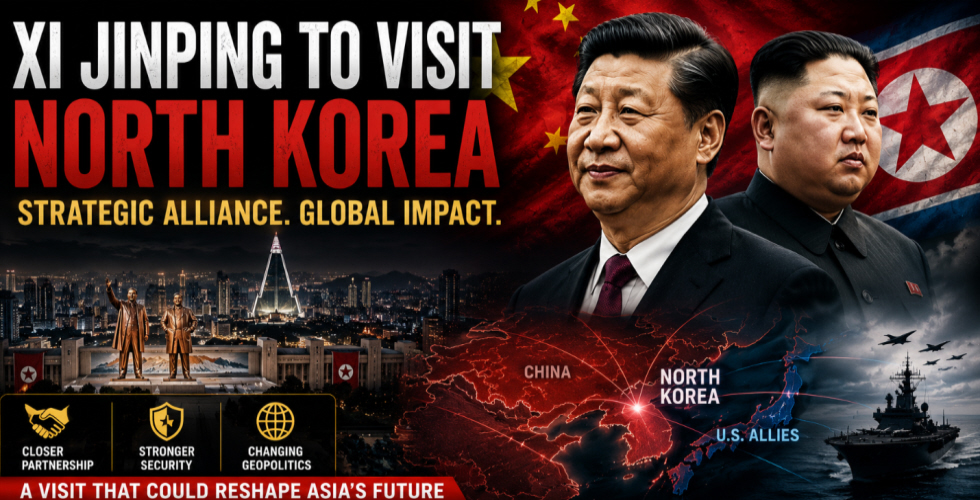
The possibility that Xi Jinping could soon visit North Korea has begun generating strong diplomatic reactions across Asia and the West. Reports from government sources indicate that the Chinese president may travel to Pyongyang within the coming days as part of a renewed strategic push between the two neighboring nations. According to high-level officials, intelligence agencies have reportedly detected logistical and diplomatic preparations connected to the potential visit.
Among the strongest signals are the recent movements of Chinese security personnel and ceremonial staff into the North Korean capital, developments that usually precede high-profile presidential meetings. The possible trip comes at an especially sensitive moment for the Asia-Pacific region. Rising tensions surrounding Taiwan, the growing
American military presence in South Korea and Japan, and expanding regional alliances have intensified strategic competition between Washington, Beijing, and Pyongyang. During a recent meeting with Chinese Foreign Minister Wang Yi, North Korean leader Kim Jong-un expressed his willingness to strengthen high-level exchanges and deepen strategic communication with Beijing.
His remarks were widely interpreted as a clear signal of closer political coordination between both governments. International analysts believe an official visit by Xi Jinping to North Korea would carry enormous symbolic and geopolitical weight. Beyond reinforcing the historic alliance between the two countries, the trip would demonstrate China’s determination to maintain direct influence over one of the world’s most volatile strategic regions. Relations between Beijing and Pyongyang have gone through different phases over the decades, but both governments continue sharing strategic interests in response to Western pressure.
China remains North Korea’s most important economic partner and one of its strongest diplomatic supporters on the international stage. Regional security experts also believe the growing cooperation could further strengthen the emerging political axis formed by China, Russia, and North Korea in opposition to the United States and its Asian allies. Military, technological, and energy cooperation among these powers is being watched closely by Western governments.
The possible visit may also influence future negotiations involving international sanctions and North Korea’s military programs. Pyongyang continues developing strategic capabilities that keep South Korea, Japan, and American forces stationed in the region under constant alert. Meanwhile, Asia’s diplomatic landscape is undergoing rapid transformation.
Beijing is seeking to consolidate its regional leadership while projecting an image of political stability amid a global environment increasingly defined by military rivalries, economic disputes, and geopolitical uncertainty. Although the visit has not yet been officially confirmed by either government, diplomatic signals strongly suggest a significant strengthening of relations between China and North Korea. If the meeting takes place, the encounter between Xi Jinping and Kim Jong-un could become one of the most important geopolitical developments of the year in Asia.


