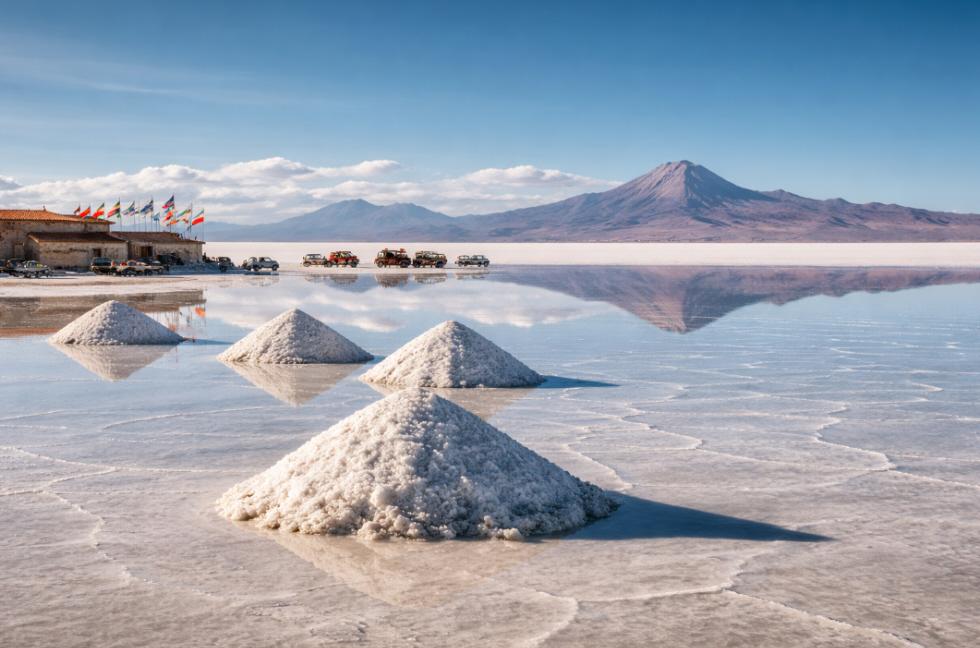
In southwestern Bolivia, where the Andean Altiplano stretches into a vast and almost unreal expanse, lies the Salar de Uyuni, a place that challenges human perception. The horizon dissolves into an endless white surface where sky and earth seem to merge, and silence becomes part of the experience itself. Traveling across this salt desert means entering a space where scale, distance, and time feel fundamentally altered.
Located at approximately 3,650 meters above sea level and covering more than 10,500 square kilometers, the Salar de Uyuni is the largest salt flat in the world. Its immense size makes it visible from space, while its near-perfect flatness sets it apart as a geological phenomenon without parallel. Each year, hundreds of thousands of visitors are drawn to its striking beauty, making it one of South America’s most iconic natural destinations. The salt flat was formed through a long geological process that began tens of thousands of years ago. During prehistoric times, massive lakes covered the region.
As these bodies of water gradually evaporated, they left behind thick layers of salt that later compressed into the extraordinarily uniform surface seen today. This ancient transformation shaped one of the most distinctive landscapes on Earth. During the rainy season, a thin layer of water spreads across the surface, turning the Salar de Uyuni into a giant natural mirror. The sky is reflected with remarkable clarity, creating optical illusions that blur the boundary between above and below. This seasonal phenomenon has made the salt flat a favored setting for photographers, filmmakers, and visual artists from around the world.
Beyond its visual impact, the Salar de Uyuni holds significant scientific value. Its extreme flatness makes it an ideal natural reference point for satellite calibration, allowing scientists to verify measurements of altitude, distance, mapping accuracy, and environmental change. Quietly and without infrastructure, the salt flat plays a role in how Earth is observed from space. The main gateway to the region is the town of Uyuni, home to just over 20,000 residents. Equipped with an airport, a railway station, and numerous tour operators, Uyuni functions almost entirely as a logistical hub for travelers heading into the salt flat.
The rhythm of the town is shaped by tourism and the constant movement of vehicles departing toward the white expanse. Salt itself remains a living part of the local economy. In nearby communities such as Colchani, salt is still harvested using traditional methods and sold for consumption and trade. The mineral has also inspired some of the region’s most unusual architecture, including hotels built almost entirely from blocks of compressed salt, offering visitors a rare experience fully integrated with the surrounding environment.
Exploration of the Salar de Uyuni is carried out primarily through organized 4×4 tours, which cross the salt flat and, on longer itineraries, connect it with colorful lagoons, volcanic landscapes, geysers, and thermal springs of the Altiplano. These journeys reveal an unexpected diversity within one of the continent’s most extreme regions. The salt flat has also played a role in modern motorsport history. For several years, it formed part of the Rally Dakar route, providing a spectacular yet demanding stage that brought global attention to the region and reinforced its image as a landscape of both beauty and endurance.
Today, subtle signs of human presence appear within this vast natural setting: marked routes, small structures, and rows of weathered flags from different countries planted in the salt. These symbolic traces stand in contrast to the overwhelming sense of openness and isolation. Despite growing tourism, the Salar de Uyuni remains a place of profound scale and quiet power—a destination that invites reflection as much as exploration.