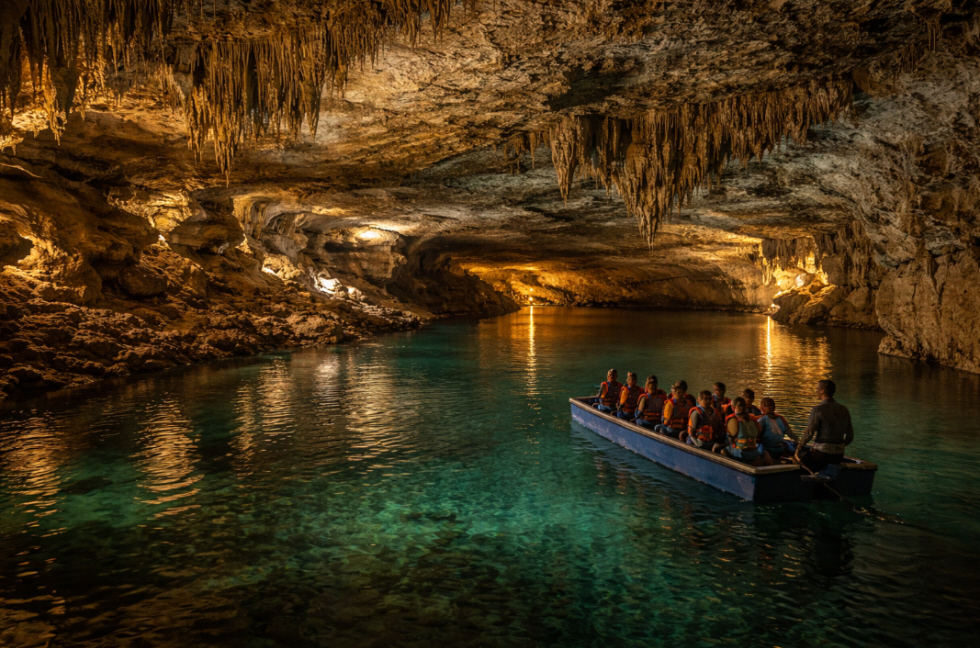
A discovery made more than a century ago has recently regained public attention due to its remarkable scale and historical significance. Beneath the ground of the United States, in the state of Tennessee, lies one of the country’s largest known underground lakes, a finding that began with the curiosity of a 13-year-old boy in the early 20th century. In 1905, a teenager named Ben Sands was exploring what is now known as Craighead Caverns when he managed to squeeze through a narrow opening leading into a vast underground chamber.
There, he encountered an enormous body of water hidden deep below the surface, a feature that would later become known as The Lost Sea. Although often described as an “underground sea,” scientists clarify that the formation is technically a freshwater lake contained within an extensive cave system. Even so, its dimensions are extraordinary: the portion that has been mapped covers more than 18,000 square meters, making it the largest non-subglacial underground lake in the United States.
One of the most intriguing aspects of the lake is that its full extent has yet to be determined. Subsequent explorations using diving equipment and modern technology have revealed additional submerged passages and chambers, but the complexity of the system has prevented researchers from establishing a definitive endpoint. Beyond its geological importance, the site holds considerable historical and cultural value.
Over the centuries, the caverns were used by Indigenous peoples and later by settlers, soldiers, and explorers, turning the location into a living record of multiple periods in American history. Today, Craighead Caverns has become a well-known tourist attraction. Visitors can explore parts of the cave system and even take guided boat rides across the lake’s surface, offering a rare opportunity to experience a unique natural phenomenon firsthand.
Geologists and scientists continue to study the lake to better understand its origin, its relationship with underground aquifers, and the processes that shaped such an expansive cavern system. These investigations contribute to broader knowledge about subterranean water networks and geological formation. Beyond the dramatic headlines, the so-called “underground sea” serves as a reminder of how much remains undiscovered beneath our feet. A discovery sparked by a young explorer’s curiosity illustrates that exploration and wonder remain essential forces in expanding human knowledge, even in the modern age.