
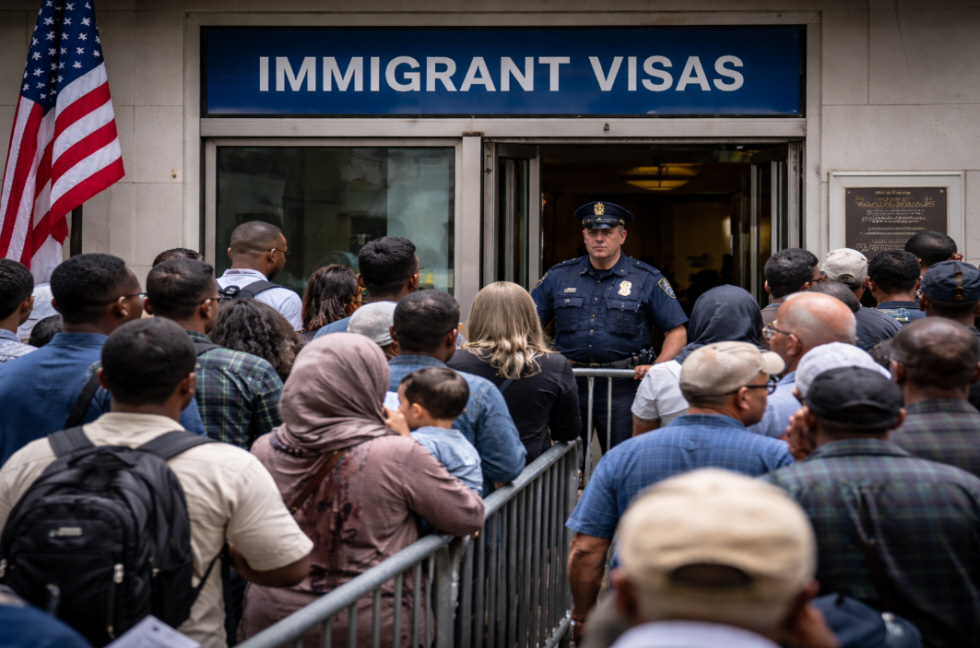
The United States has decided to suspend the processing of immigrant visas for applicants from 75 countries, a move that marks a significant shift in its immigration policy and reinforces a stricter approach based on security and fiscal sustainability. The decision, driven by the State Department, is not framed as a temporary or administrative step, but as part of a broader and deeper review of the legal immigration system.
According to the Department, the suspension aims to ensure “the highest level of screening and security vetting” for all applicants. In this context, internal guidelines, regulations, and procedures are being thoroughly reviewed to assess not only applicants’ backgrounds but also their potential impact on the U.S. welfare system. A key concept underpinning this policy is that of “public charge,” a long-standing legal principle that allows authorities to deem an immigrant inadmissible if they are considered likely to rely on government benefits.
U.S. officials argue that the system has been exploited and that the new approach is designed to prevent abuse of what they describe as the “generosity of the American people.” The measure fits within a more restrictive immigration agenda consolidated since Donald Trump’s return to the presidency. Independent policy analysts have described this approach as one of the most comprehensive crackdowns on legal immigration in modern U.S. history, with direct consequences for hundreds of thousands of applications expected in the coming years.
Although visitor visas are not affected, the suspension of immigrant visa processing sends a clear signal to the international community: legal and permanent entry into the United States will be subject to more demanding criteria and a broader evaluation of applicants’ economic and social profiles, beyond traditional requirements. The global scope of the decision is striking. The list of affected countries spans multiple regions, levels of development, and diplomatic relationships with Washington, underscoring that the policy is not a response to a specific conflict, but rather a general redefinition of priorities in U.S. immigration policy.
The international context adds another layer of complexity. The United States is set to host major global events such as the 2026 World Cup and the 2028 Olympic Games, highlighting the contrast between its role as an international host and its tightening stance on permanent immigration. Beyond domestic political debate, the suspension of immigrant visa processing raises a fundamental question: if the United States is moving toward a more selective and restrictive immigration model focused on security and economic self-sufficiency, what will this shift mean for its long-standing image as a land of opportunity and social mobility? The answer remains open, but the signal has been clearly sent.
By:
Williams Valverde

