
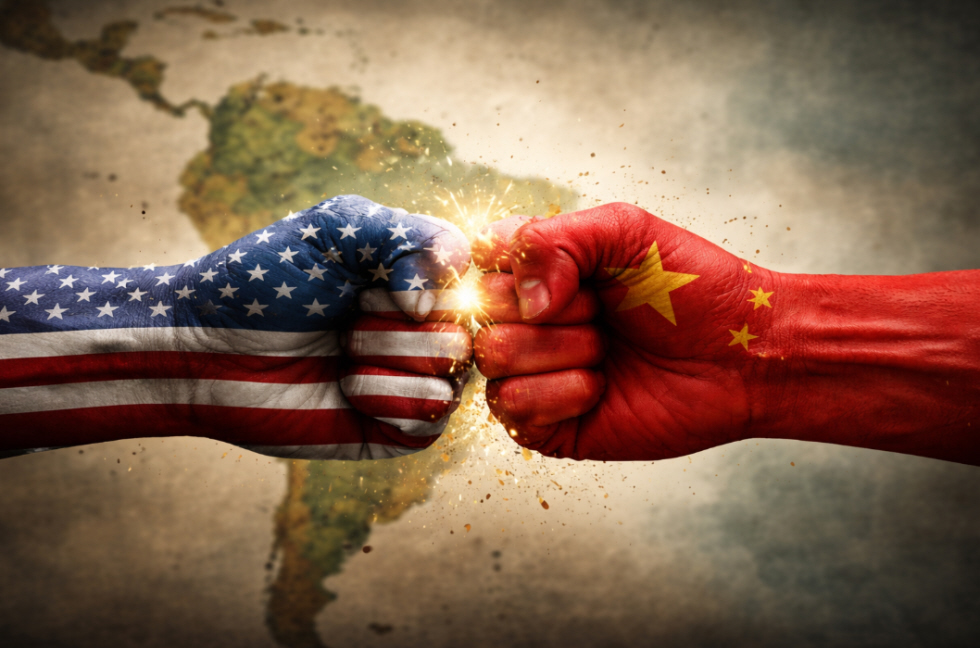
In the current political realignment of Latin America, China is no longer observing a region naturally opening to its influence, but rather a landscape that is increasingly fragmented and, in many cases, less favorable to its long-term strategic interests. Recent government changes across the region point to a clear shift toward more pragmatic or openly center-right administrations that prioritize renewed ties with United States, reducing the space China had steadily built over the past decade. What was once seen in Beijing as a promising sphere of expansion now shows signs of political rebalancing and geopolitical pushback.
The case of Bolivia is particularly illustrative. The transition from a left-leaning government to an administration more inclined toward the right, actively seeking closer relations with Washington, represents a direct setback for China’s positioning in the Andean region. This trend is even more pronounced in Argentina, where the political shift has come with explicit criticism of China and a strong emphasis on restoring ties with the United States and Western financial institutions. Paraguay, long aligned with Washington and Taipei, reinforces this trajectory, while Chile, despite internal nuances, has adopted a more cautious and selective approach toward Beijing.
Within this evolving map, only Brazil and Venezuela remain as clear political strongholds of alignment with China, though even there the relationship appears increasingly driven by economic necessity rather than ideological affinity. From Beijing’s perspective, this shift poses a significant challenge. China’s traditional approach in Latin America—focused on infrastructure investment, trade, and credit with minimal political conditionality—works best in environments of institutional continuity and long-term policy stability. Ideological swings toward governments that favor closer alignment with the United States undermine China’s ability to consolidate long-range projects and introduce uncertainty into previously negotiated agreements.
As a result, Beijing seems to be adopting a more defensive and selective posture, concentrating its efforts on countries where it still retains leverage, while cautiously watching Washington regain ground in areas once considered strategically secured. The conclusion is uncomfortable but increasingly evident: Latin America is entering a phase of geopolitical recentralization, in which the United States is recovering influence and China is encountering clearer limits to its regional expansion.
For Latin American countries, the challenge will not be choosing between one power or another, but avoiding a return to dependency driven by ideological pendulum swings. In a rapidly evolving multipolar world, the real opportunity lies in building a coherent and autonomous foreign policy—one capable of engaging with all global actors while remaining firmly anchored in national and regional interests rather than external agendas.
By:
Williams Valverde.


