
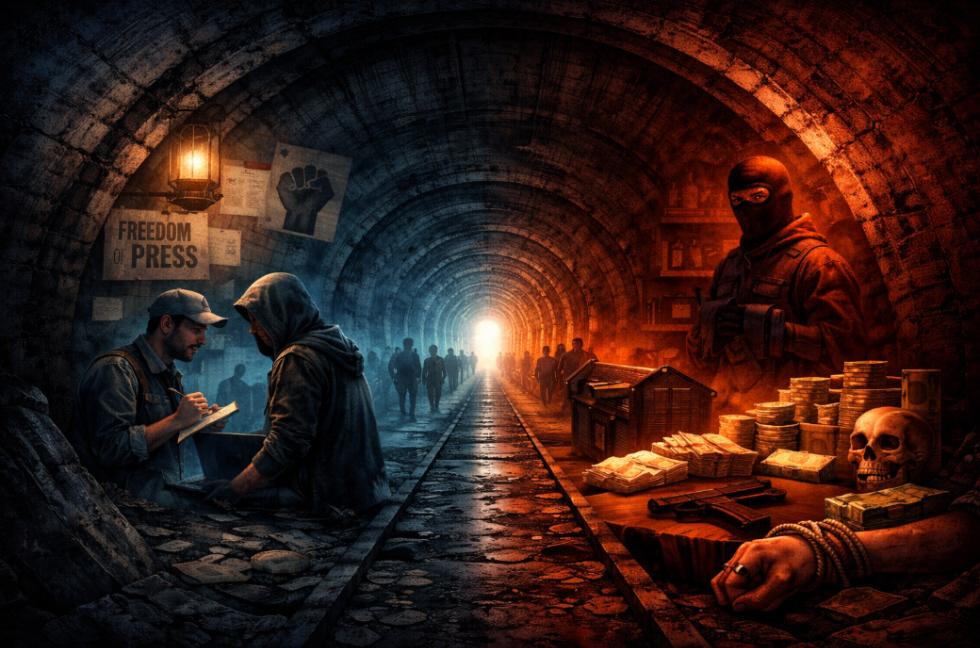
The dark web has become one of the most misunderstood digital territories of our time. For many, it is immediately associated with crime, violence, and moral decay; for others, it is a mythical space where anything is possible and no rules apply. The reality, however, is far more complex. The dark web is neither a physical place nor a criminal organization, but a collection of networks and services accessed through technologies designed to prioritize anonymity, with Tor being the most widely known.
Its original purpose was not to facilitate crime, but to enable private communication in contexts where censorship, state surveillance, or political persecution put lives and freedoms at risk. Over time, that same anonymity began to attract activities unable to operate within the open web, giving rise to illegal markets, clandestine networks, and parallel economies.
Within this hidden ecosystem, phenomena such as prostitution and sexual exploitation take on particularly alarming forms. Unlike the open web, where legal frameworks, partial oversight, and avenues for reporting exist, the dark web allows advertisements, intermediaries, and networks to operate with virtually no supervision. This dramatically increases the risk of human trafficking, coercion, violence, and the exploitation of minors. Anonymity does not protect victims; instead, it often shields perpetrators, making identification, rescue, and prosecution extremely difficult.
The absence of visibility and accountability turns these spaces into fertile ground for systemic abuse that rarely reaches public awareness. A similar dynamic applies to one of the most disturbing myths surrounding the dark web: organ trafficking. While many circulating stories are exaggerated or fabricated, there are indications that criminal networks use hidden channels to contact intermediaries, falsify medical documentation, or coordinate illegal procedures in countries with weak healthcare systems.
The dark web does not create this practice, but it facilitates its logistics, secrecy, and transnational reach, connecting supply and demand in a market where human life is reduced to a commodity. The traffic that flows through the dark web does not arise spontaneously. Behind it lies a technical infrastructure that relies on the same physical internet used worldwide.
There are no “dark web internet providers” as such; users access it through conventional internet companies and then rely on software that routes data through multiple nodes distributed globally. These nodes are operated by volunteers, academic institutions, and private individuals, many of whom aim to protect privacy and freedom of expression.
The paradox is clear: a network designed to safeguard fundamental rights can also be exploited by those who violate them. This inevitably raises a difficult question: does Tor contribute to crime? The honest answer is uncomfortable. Tor does not order crimes or actively promote them, but its architecture lowers the risks for those who choose to operate outside the law.
It did not emerge by chance; it was developed by researchers and partially funded by institutions seeking secure communications. Like any powerful technology, it is not socially neutral. It enables both the exposure of abuses and their concealment, both legitimate resistance and organized crime. Comparisons with the Sicilian mafia of the 1920s are not entirely misplaced if properly understood. Just as alcohol prohibition created a black market that allowed organized crime to consolidate power, digital anonymity has created spaces where crime reorganizes and adapts.
The difference is that today there are no visible territories controlled by armed men, but decentralized networks, cryptocurrencies, and digital reputations. Modern criminal organizations no longer require physical streets or speakeasies; silence, technology, and demand are enough. In authoritarian regimes such as China, the use of the dark web takes on a very different meaning. There, it is not a space of curiosity or transgression, but one of informational survival. Journalists, academics, and activists rely on anonymous networks to access censored information, communicate with the outside world, and expose abuses, fully aware that merely using these technologies can carry severe legal consequences.
Paradoxically, the same state that persecutes digital anonymity often leverages similar tools for its own strategic purposes, revealing that the issue is not the technology itself, but who is allowed to use it and for what ends. Reducing the dark web solely to a criminal domain would therefore be a dangerous oversimplification. Within that same digital space, investigative journalists, whistleblowers risking their lives, persecuted activists, and ordinary citizens seeking privacy in an increasingly surveilled world find refuge. The technology that enables anonymity was not designed for crime, but as a response to censorship and excessive control.
The real problem is not the existence of these tools, but the ethical, legal, and social vacuum that allows them to be used without limits or accountability. The dark web is neither inherently good nor evil; it is an uncomfortable mirror of our societal contradictions. It is a place where legitimate resistance and organized crime coexist, reminding us that technology amplifies both the best and the worst of human behavior. Not everyone who lives in the darkness does so by choice. Some ended up there because the light was denied to them. Giving them a voice does not require entering their world, but ensuring that ours does not ignore them.
By:
Williams Valverde.

