
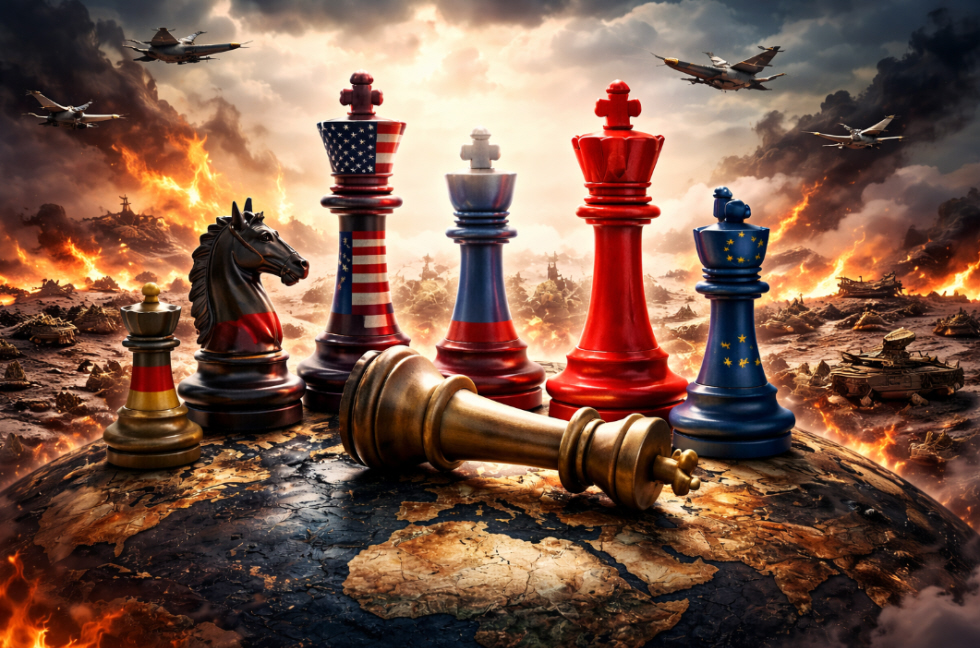
For decades, the idea of a “new world order” was discussed as if it were a clearly designed system, with defined rules and fully aware actors. Recent events, however, suggest a different reality: the world is not entering a new order, but rather experiencing a deep disorder, and major powers are reacting by trying to impose limits where they still can. The United States appears to have concluded that the era of passive containment has ended.
The message is no longer subtle or strictly multilateral: global disorder must be managed, and that process of “reordering” begins in arenas where the political and military cost is lower, but the strategic signal is unmistakable. In this sense, Venezuela is not the final objective, but the opening message. This is not only about Latin America. It is about demonstrating that there are still regions where the willingness to impose limits remains intact. The reaction from China and Russia was telling: measured statements, occasional rises in rhetoric, but no concrete action. Operational silence is also a form of communication.
Neither power was prepared to risk a broader conflict over Caracas. This episode leads to an uncomfortable conclusion: the multipolar world exists more in discourse than in reality. In certain scenarios, the hierarchy of power remains clearly defined. A new order is not being inaugurated; an old one is being reaffirmed. The contrast with Ukraine reinforces this point. Despite financial, military, and logistical support, Ukraine is fighting alone on the battlefield. There are no U.S. troops and no permanent American bases. Moscow understands this reality and acts accordingly, seeking to consolidate territorial gains before the rules of engagement potentially change.
The true red line is not weapons deliveries, but something far more concrete: direct U.S. military presence. The day Washington establishes a military base in Ukraine, the conflict would immediately cease to be regional. Russia would no longer be confronting Kyiv alone, but the United States itself—and that would be the moment when Russia’s real power would be tested. Within this broader context, the role of the European Union appears increasingly marginal. Europe is an economic powerhouse, but not a decisive geopolitical actor.
It lacks a unified foreign policy, a truly autonomous military force, and the willingness to bear strategic costs. Its dependence on the United States for security reduces it to a supporting role rather than a leading one. In practice, the European Union has a single sponsor: Germany. Yet Germany is an economic sponsor, not a military one. This distinction lies at the heart of Europe’s strategic paralysis. Berlin sustains the system financially but does not direct it through hard power. This limitation is not accidental. Germany carries a deep historical trauma stemming from its defeat on the Eastern Front during the Second World War.
The campaign fought on Soviet territory—conducted without adequate preparation for climate or terrain—left a lasting imprint on generations of German political thought. The winter, the mud, and the vast distances were not merely obstacles; they were the punishment for strategic arrogance. Germany entered that war convinced that speed, ideology, and sheer willpower would suffice. It believed slogans, loyalty to the leader, and symbolic unity could replace logistical planning and environmental understanding. The battlefield proved otherwise. Wars are not won with slogans. The battlefield does not listen to speeches. It is not impressed by symbols or ideology.
Cold freezes indiscriminately, mud halts all armies equally, and hunger spares no one. Germany learned this lesson in the harshest possible way and transformed it into a political doctrine: never again should military force be a central instrument of power. That doctrine, while effective in preventing past mistakes, today limits Europe’s ability to act in a disordered world. While other powers accept force as a political tool, Europe hesitates, negotiates, and reacts late. History shows that wars are not won through blind faith or grand narratives.
They are won—or lost—through preparation, realism, and adaptation to reality. Confusing ideology with reality has always been a reliable path to defeat. Perhaps this is the most relevant lesson today. In a world filled with power speeches, military parades, and promises of greatness, the reality of the battlefield remains the final judge. And it has never believed in slogans.
By:
Williams Valverde


