
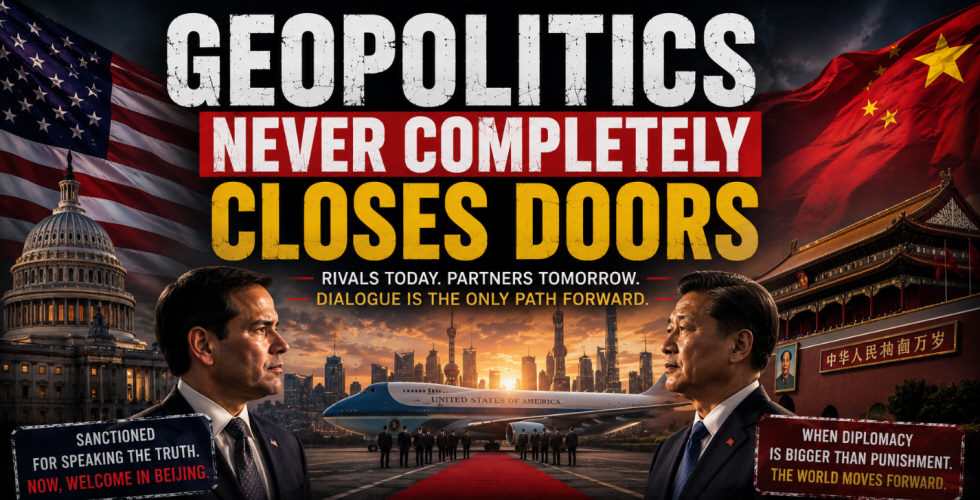
Modern international relations are often filled with contradictions that are difficult to ignore. One of the latest examples emerged with the visit of Marco Rubio to China despite the fact that the American official had previously been sanctioned by Beijing. For years, Rubio became one of the strongest critics of the Chinese government within American politics. Now, the same power that once punished him appears willing to reopen its doors. The situation reflects how global geopolitics rarely operates under absolute rules. Political sanctions are frequently used as symbolic pressure tools, but they often evolve according to strategic necessities.
China sanctioned Rubio because of his positions regarding human rights, Hong Kong and the treatment of the Uyghur Muslim minority. However, once high-level diplomacy enters the equation, ideological tensions can quickly become secondary. During his years as a senator, Rubio supported legislation designed to increase international pressure on Beijing. The Republican politician publicly condemned the crackdown on pro-democracy activists in Hong Kong and criticized China’s treatment of Muslim communities in Xinjiang. His statements triggered strong reactions from Chinese leadership.
Beijing responded by imposing sanctions and travel restrictions against him. Now, the political landscape looks completely different. Rubio no longer appears only as a critical senator but as a key figure within the diplomatic structure of the administration of Donald Trump. That reality forces both powers to approach the relationship with far greater pragmatism. The need to preserve communication channels now appears more important than previous political disputes. International diplomacy rarely allows permanent ruptures between major global powers. China’s decision also highlights the extraordinary complexity of the relationship between Washington and Beijing.
Both countries compete for global influence in economic, technological and military sectors while simultaneously needing to maintain minimum levels of cooperation. International trade, financial stability and regional security depend heavily on dialogue between the world’s two largest economies. Even amid deep rivalry, communication remains unavoidable. In many ways, the Rubio case demonstrates the practical limits of international sanctions. Political measures often function as diplomatic messages directed both internationally and toward domestic audiences. Yet when larger strategic interests emerge, those restrictions can quickly be reinterpreted or softened.
International politics tends to move more according to necessity than ideological consistency. The episode also exposes the enormous role pragmatism plays in modern diplomacy. Governments may maintain aggressive public rhetoric while quietly negotiating behind closed doors at the same time. In global politics, strategic rivals are often eventually forced to sit at the same table. The United States and China currently represent one of the world’s most complex rivalries, but neither side can completely ignore the other. The situation further reflects how personal sanctions have become increasingly common tools in modern diplomatic conflicts.
Both Washington and Beijing use blacklists, visa bans and economic restrictions to send political signals. However, these measures rarely result in total diplomatic isolation. In practice, major powers continue communicating even while publicly exchanging accusations and pressure. The episode may also reveal the strategic importance both countries continue holding for one another. Despite growing competition for global leadership, both Washington and Beijing understand that a complete breakdown in relations would carry unpredictable economic and geopolitical consequences.
Global trade, financial markets and international military balance partially depend on the stability of that relationship. Neither side appears prepared to completely abandon dialogue. From a political perspective, Rubio’s visit could trigger mixed reactions both inside the United States and within China itself. Some sectors may view the situation as contradictory given Beijing’s previous sanctions against him. Others may interpret the episode as evidence of diplomatic maturity and political realism. During periods of high international tension, major powers often prioritize strategic stability over total confrontation.
Beyond the specific details of the trip, the episode offers a broader reflection on how global power truly operates. Sanctions, public statements and ideological speeches are often part of a much larger ongoing negotiation between governments. What appears today as irreconcilable confrontation may tomorrow evolve into strategic dialogue. International politics is rarely completely linear.
In the end, the Marco Rubio case demonstrates that modern diplomacy continues operating between rivalry and mutual necessity. China and the United States will likely continue competing for global influence for years to come, yet they will also remain forced to communicate with one another. Sanctions may harden political rhetoric, but they do not always fully close the door. In the world of geopolitics, strategic interests almost always end up outweighing personal differences.
By:
Williams Valverde


