
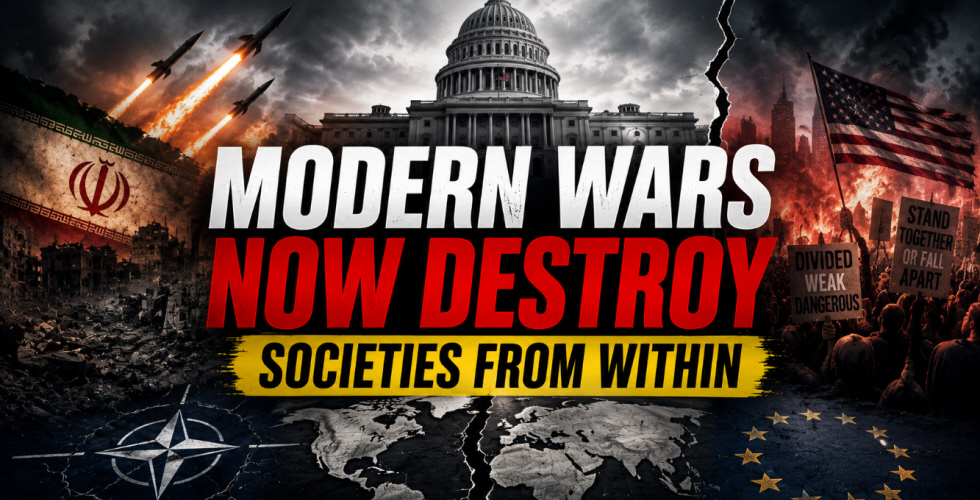
Modern wars are no longer fought only on distant battlefields. Increasingly, international conflicts are beginning to divide entire societies from within, weakening political institutions, creating social fractures, and intensifying tensions inside the world’s leading democracies. What happens beyond national borders now produces direct consequences at home. In United States, the conflict involving Iran has reopened a major political confrontation between the White House and sectors of Congress.
The debate surrounding presidential authority to conduct prolonged military operations demonstrates how international tensions are now directly affecting internal institutional stability. Meanwhile, inside NATO, signs of strategic fatigue are also beginning to emerge. Discussions about reducing American troop deployments across Europe reflect how even long-standing alliances are entering periods of uncertainty in an increasingly fragmented and competitive world. Europe itself faces growing internal challenges. Rising military spending, energy pressures, migration concerns, and fears of broader regional conflicts are gradually transforming the political climate across several European nations.
Security has once again become a central political priority throughout the continent. At the same time, social media platforms and digital communication networks amplify every international crisis in real time. Images of wars, attacks, and global threats circulate constantly before millions of people, fueling collective anxiety, political polarization, and a permanent sense of worldwide instability. Modern warfare is now also being fought economically. Sanctions, tariffs, technological restrictions, and energy disputes are directly impacting the daily lives of millions of citizens.
What once seemed like distant diplomatic tensions now affects fuel prices, food costs, employment, and financial stability across entire societies. In this new global landscape, artificial intelligence and advanced technologies have also become instruments of geopolitical power. The growing struggle among governments, corporations, and technology companies for control over data, innovation, and digital infrastructure demonstrates that the 21st century’s greatest battles may be technological as much as military. Many citizens are also beginning to lose confidence in traditional democratic institutions.
Divided parliaments, increasingly confrontational governments, and extremist political rhetoric are strengthening the perception that modern democracies are entering a period of visible political fragility. The situation becomes even more dangerous because several nuclear powers are now indirectly involved in multiple global confrontations at the same time. Russia, China, the United States, and other strategic actors continue escalating geopolitical rivalries to levels not seen in decades. However, the greatest danger may not be military alone. The real threat could be the gradual normalization of permanent crisis.
Societies are slowly becoming accustomed to living under constant geopolitical tension, economic uncertainty, and worldwide instability as part of everyday life. Paradoxically, while the world is more technologically connected than ever before, political and cultural divisions appear to deepen every day. Modern wars no longer separate only hostile nations; they increasingly divide citizens living within the same societies and democracies.
History has repeatedly shown that major conflicts transform entire civilizations far beyond the battlefield itself. Today, the world appears to be entering another era in which political, economic, and social stability will depend not only on avoiding external wars, but also on preventing those wars from slowly destroying the internal cohesion of modern democratic societies.
By:
Williams Valverde


