
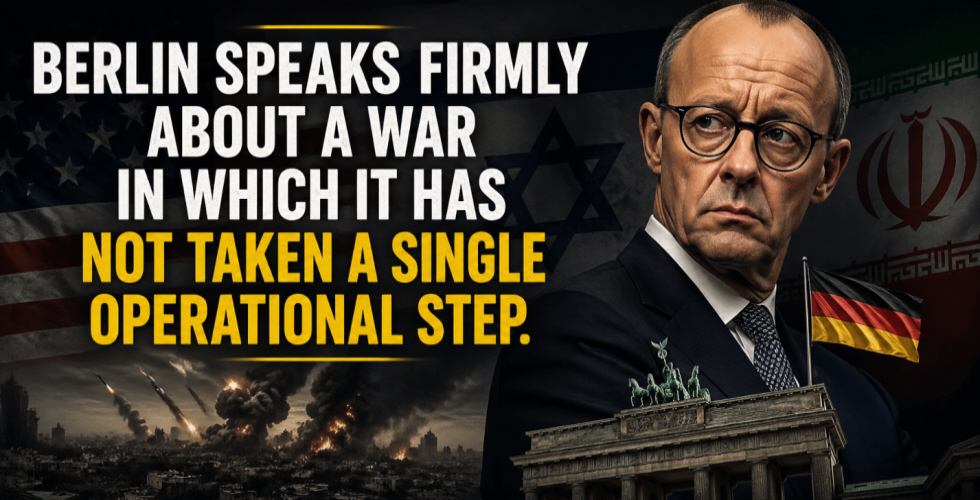
Germany has every right to express concern about the economic consequences of the conflict between the United States and Iran, especially because of the energy and commercial impact that directly affects Europe. Rising oil prices, market instability, and threats to international maritime routes strongly affect Berlin. No one can deny that the European continent is paying a significant part of the geopolitical bill. However, suffering the consequences is one thing, and leading the strategic decisions is something very different.
The recent statements by German Chancellor Friedrich Merz, claiming that the United States is being humiliated by Iran, opened a debate that goes far beyond simple diplomatic opinion. The phrase was strong, direct, and had an obvious international impact. But it also left an unavoidable question on the table: to what extent does Germany have the political authority to make that kind of judgment in a war in which it does not directly participate? Berlin has not assumed the immediate military cost or the main operational responsibility within the conflict. It is not sending troops, leading operations, or carrying the daily pressure of decisions that can change the balance of the Middle East within hours.
Its role has been mainly economic, diplomatic, and observational. From that position, criticizing is easier than acting under real fire. The United States, Israel, and Iran are the actors that truly carry the strategic weight of this confrontation. Washington manages international and military pressure, Tel Aviv faces direct existential threats, and Tehran defends its regional power structure. Germany watches from a distance—affected, yes, but without the same level of immediate exposure. That difference deeply changes the legitimacy of certain political narratives. Europe, in general, seems trapped between paying the consequences and not controlling the decisions.
That frustration is understandable, especially when inflation, energy costs, and economic uncertainty hit millions of citizens. But turning that frustration into a high-profile public criticism of Washington can be politically risky. Diplomacy requires more precision than impactful headlines. This is not about automatically defending every American move or justifying obvious strategic mistakes. The United States has also made serious miscalculations in its policy toward Iran, and that is part of the legitimate international debate. However, reducing everything to a supposed humiliation may oversimplify a much more complex reality.
Geopolitics is rarely explained by a single word. When a conflict involves decades of tensions, sanctions, covert operations, and regional threats, speaking of immediate victory or defeat can be premature. Iran has resisted enormous pressure for years, and the United States remains the world’s leading military power. The dispute is not measured only by statements, but by endurance, influence, and long-term results. Germany should consider that dimension before issuing categorical judgments. There is also a visible contradiction in the European position: demanding influence without fully assuming the risks of strategic leadership.
Many European governments demand greater participation in global decisions, but at the same time keep their distance when the military cost becomes real. That duality weakens the credibility of their criticism. Leadership also means carrying the hardest consequences. More than a public condemnation, what many expect from Berlin is a concrete proposal for diplomatic balance. Germany could play a more useful role as a bridge for negotiation rather than as a severe commentator from the international grandstand.
Global stability needs effective mediators, not only statements that generate headlines. Real influence is demonstrated through results, not through strong phrases. In international politics, authority is not built only with economic power, but also with decision-making capacity and direct responsibility. Europe pays an important part of this crisis, but it does not define the main direction of the conflict. That is why, when Germany harshly judges the strategy of others, it also exposes its own limitations. Geopolitics is not sustained by speeches, but by real weight in action.


