
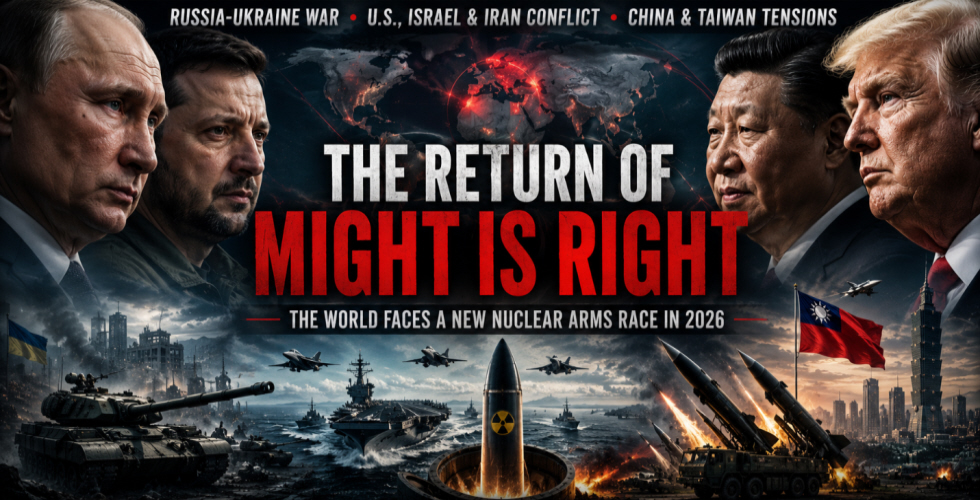
The international landscape of 2026 is showing a profound shift in the way major powers defend their strategic interests. Military force is once again becoming a central element of global politics after years of rising geopolitical tensions. Regional conflicts, territorial disputes and economic rivalries are reshaping the international balance of power. For many analysts, the world is entering a new era defined by open strategic competition and military pressure. The war between Russia and Ukraine remains one of the clearest symbols of this geopolitical transformation. What began as a regional conflict eventually altered diplomatic, economic and military relations across Europe and beyond.
The war has triggered massive defense investments and accelerated weapons modernization programs worldwide. It has also demonstrated that conventional warfare remains a real threat in the twenty-first century. In the Middle East, tensions involving United States, Israel and Iran have increased fears of a broader regional confrontation. Military operations, targeted strikes and escalating rhetoric continue to place the region under heavy international pressure. Global energy markets react nervously to every sign of escalation or instability. The security of oil and gas supplies has once again become a strategic global concern. Meanwhile, China continues to intensify political and military pressure on Taiwan. Naval exercises, military flights and operations surrounding the island have raised tensions across the Pacific region.
The United States and its allies are carefully monitoring Beijing’s actions due to the risk of a major regional conflict. As a result, the Indo-Pacific has become one of the most sensitive geopolitical flashpoints in the world. Faced with this environment, many smaller and medium-sized nations are reconsidering their national defense strategies. Governments that once prioritized diplomacy and economic integration are now increasing military spending and strengthening security alliances. Some countries are seeking advanced deterrence systems while others are debating independent defense capabilities. The growing fear is that vulnerability could become dangerous in a world increasingly driven by power politics.
Concerns over a new global arms race are also expanding within international institutions and security circles. Defense analysts warn that rising military expenditures could trigger a competition similar to the Cold War era. Major powers are accelerating programs involving hypersonic missiles, nuclear submarines and artificial intelligence-based weapons systems. Military technology is advancing at a pace that deeply worries diplomats and strategic experts. The debate surrounding nuclear weapons has once again returned to the center of global strategic discussions. Several governments believe nuclear capability remains the ultimate guarantee against external aggression. This mindset is generating concern in regions where arms-control agreements once provided relative stability.
The possibility of additional nations pursuing nuclear deterrence is becoming an increasingly serious international issue. Artificial intelligence and military drones are also transforming the nature of modern warfare. Automated systems capable of making tactical decisions in real time are already being integrated into military operations around the world. Global powers are no longer competing only through troop numbers or firepower, but also through technological superiority. Future wars may increasingly depend on machines, algorithms and autonomous combat systems.
Economically, this growing militarization is creating major consequences for governments and financial markets. Nations are allocating billions of dollars toward defense while simultaneously facing inflation, debt and slowing economic growth. Industries connected to security, weapons manufacturing and advanced technology are experiencing rapid expansion fueled by global uncertainty. At the same time, geopolitical instability continues to affect trade, investment and international financial confidence.
Many experts believe the international order established after World War II is entering one of its most fragile periods. Diplomacy still exists, but it is increasingly accompanied by military demonstrations and strategic pressure between powerful nations. The fear among many governments is that the world may be moving toward a prolonged era of indirect confrontation between major powers. The defining question of 2026 is whether enough diplomatic space still exists to prevent a much larger global escalation.


