
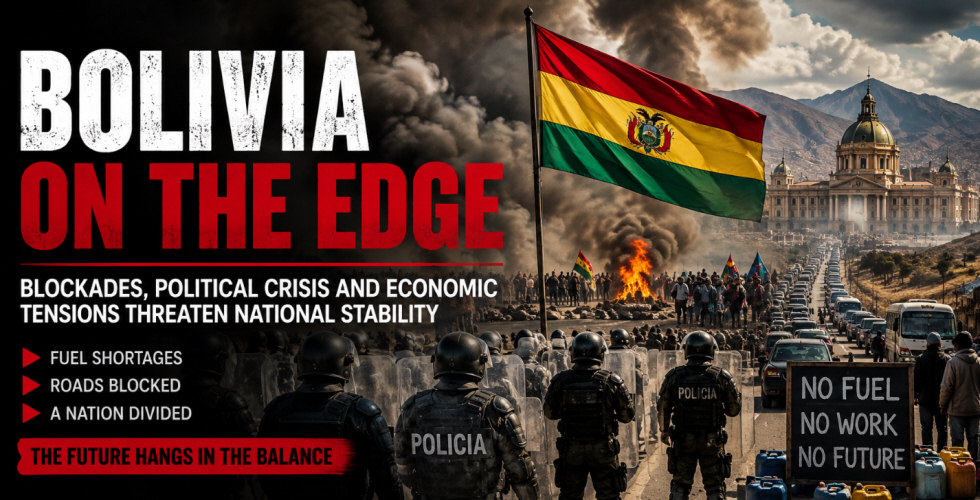
Social and political tensions have once again shaken Bolivia as road blockades, mass demonstrations and long fuel lines began paralyzing several regions of the country. What initially appeared to be an isolated economic reaction quickly evolved into a national crisis with growing political, social and financial consequences. Uncertainty continues to rise both inside and outside the country amid fears of a prolonged national shutdown. In cities such as La Paz, El Alto and Cochabamba, thousands of citizens are struggling daily to obtain fuel and basic supplies.
Interprovincial transportation services have started reducing operations, while several markets reported rising prices due to distribution difficulties. Merchants and small business owners warn that the situation could worsen significantly if the blockades continue over the coming days. The economic impact is already beginning to hit sensitive sectors of the Bolivian economy. Transport unions report major financial losses caused by interrupted trade routes, while agricultural producers fear they may no longer be able to move goods toward major urban centers.
Analysts warn that business confidence could deteriorate even further in a country already facing pressure from low international reserves and inflation concerns. The crisis also once again exposes the enormous capacity for social mobilization that has historically defined Bolivia. Labor unions, peasant movements, mining cooperatives and regional organizations continue to maintain considerable political influence capable of paralyzing national activities within days. For many groups, street protests remain the most effective mechanism for pressuring political power. However, behind the economic demands, a strong political dimension has also emerged.
Various critics of the so-called “Evo movement” argue that part of the mobilization effort is also intended to politically protect Evo Morales as investigations and legal processes threaten his political future. The former president still retains substantial support among unions and strategic rural sectors. Morales’ allies reject those accusations and insist the protests are primarily a response to the country’s worsening economic conditions. According to their leaders, the current administration has failed to stabilize the financial situation or guarantee sufficient fuel supplies.
They also accuse authorities of attempting to criminalize social protests in order to weaken political opponents. Meanwhile, divisions within the former ruling political bloc continue to deepen. The fracture between Morales-aligned sectors and other political factions has further weakened institutional stability at an extremely delicate moment for the country. Many observers believe Bolivia is simultaneously facing an economic crisis and an internal struggle over the nation’s political future. One of the most debated questions is how prolonged demonstrations can be sustained amid an already fragile economy. Analysts explain that Bolivia possesses historically organized union and community structures capable of coordinating food distribution, transportation and logistical support during multi-day protests.
At the same time, suspicions continue growing that certain political groups may also be using these mobilizations as strategic pressure tools. Ordinary citizens are increasingly feeling the strain directly. Families spend hours attempting to secure fuel, while small businesses suffer declining sales and informal workers face daily financial losses. Concern is especially growing among those who rely on daily commerce and small-scale economic activity to survive in an already difficult environment.
Specialists warn that no country can maintain sustainable growth under constant uncertainty and repeated economic paralysis. Private investment typically reacts negatively when nations face ongoing blockades, institutional conflicts and fears of political instability. Bolivia now faces the challenge of balancing legitimate social pressure with the need for long-term economic stability. Some economists compare the current situation with Asian economic models where institutional stability allowed decades of sustained economic expansion. In contrast, Bolivia continues struggling through cycles of political tension, regional conflict and recurring social unrest.
The debate over the need for stronger economic, political and legal stability has once again moved to the center of national discussion. The international community is also closely monitoring developments. Bolivia possesses major strategic resources, including significant lithium reserves that continue attracting global interest. A deeper escalation of the conflict could affect future investment plans and generate wider regional concerns regarding political and economic stability in South America.
On the streets, however, the crisis carries a far more human face. Drivers trapped for hours, families worried about food and fuel supplies, and merchants desperately trying to protect their businesses reflect the daily impact of a conflict that now extends far beyond a simple sector protest. Social tension is increasingly mixing with exhaustion and collective fear. Bolivia now faces one of its most delicate moments in recent years.
The challenge will not simply be resolving the blockades or stabilizing the economy, but building an institutional model capable of offering predictability, stability and confidence without eliminating the powerful social participation that has historically shaped the country’s political identity. The immediate future may ultimately depend on dialogue and the ability to prevent the crisis from deepening even further.


