
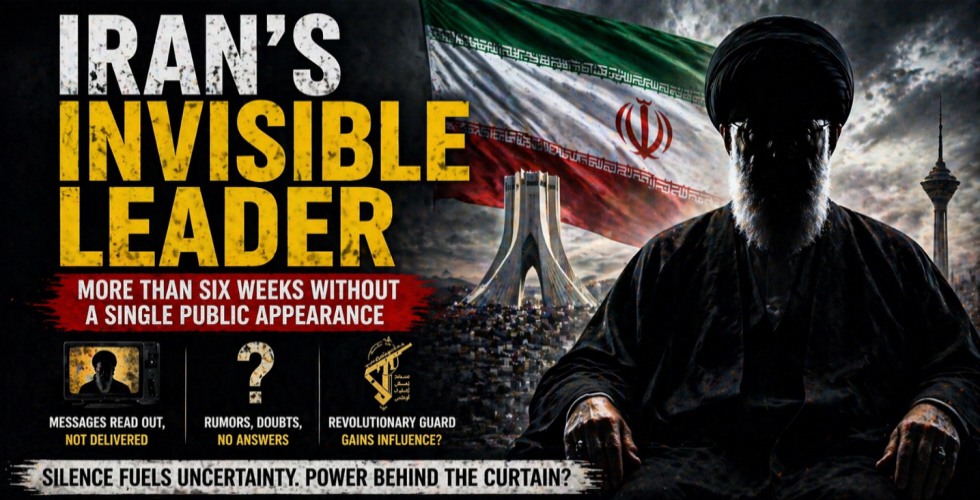
More than six weeks after being announced as Iran’s new Supreme Leader following the death of his father, Mojtaba Khamenei remains absent from public view. In the middle of one of the most dangerous moments for the Islamic Republic in decades, Iranians have neither seen nor directly heard from the man now leading the system. His silence has triggered growing speculation. Questions about stability are becoming louder. The succession followed the death of Ali Khamenei after the escalation of regional conflict and the internal shock that followed. The leadership transition was expected to project strength and continuity.
Instead, the prolonged invisibility of Mojtaba has produced uncertainty inside and outside Iran. Power without presence creates political tension. Official messages attributed to Mojtaba Khamenei have been delivered through state television, written statements and social media channels controlled by the regime. However, the absence of a direct public appearance has fueled rumors about his physical condition and real capacity to govern. Some reports suggest he may still be recovering from injuries suffered during the same attack. Others point to internal security concerns.
Iranian authorities have avoided giving detailed explanations, choosing instead to emphasize continuity and institutional control. The regime appears determined to prevent any perception of weakness during a period of extraordinary regional pressure. Tensions with the United States, Israel and the broader Middle East crisis have made leadership optics critically important. Silence itself has become political. Speculation has also grown around the role of the Islamic Revolutionary Guard Corps, which many analysts believe now holds even greater influence behind the scenes. In moments of uncertainty, real power often shifts away from formal titles and toward security structures.
The absence of the Supreme Leader naturally increases attention on who is making strategic decisions. Tehran’s internal balance may be changing. Some international observers have questioned whether the government’s communication strategy is designed to protect Mojtaba Khamenei or to conceal a deeper internal struggle. Reports involving heavily managed appearances and even claims of AI-generated imagery have intensified the debate. While such claims remain difficult to verify, they reflect the unusual level of opacity surrounding the succession. Trust becomes harder to sustain.
For ordinary Iranians, the issue is not only symbolism but legitimacy. In a political system built around the authority of the Supreme Leader, visibility matters. Public presence is part of power itself. A leader who governs only through statements risks appearing distant at a time when the country faces economic strain, military pressure and public anxiety.
As Iran navigates one of the most fragile transitions in its modern history, the absence of Mojtaba Khamenei may prove more consequential than any speech. The world is watching not only who leads Iran, but how that leadership is exercised. In Tehran, silence can be louder than declarations. And sometimes the invisible leader becomes the biggest story of all.


