
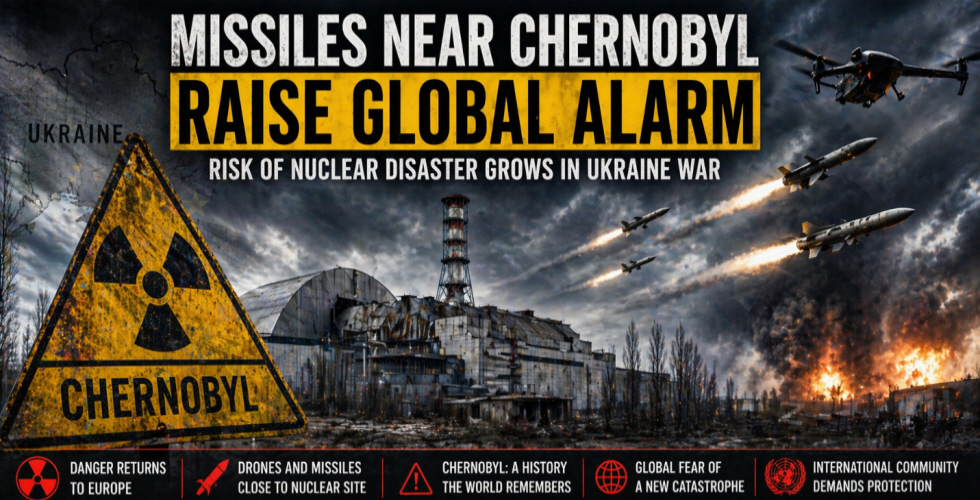
Recent drone and missile attacks across Ukrainian territory have once again raised one of Europe’s greatest fears: the risk of a nuclear accident near the Chernobyl zone. Ukrainian authorities reported that Russian projectiles have repeatedly passed close to sensitive facilities, increasing international alarm. The concern goes far beyond military activity. It also revives one of the continent’s most traumatic memories. According to Ukrainian officials, several long-range missiles and attack drones have crossed routes dangerously close to the plant and its containment structure.
Although no direct strike on the protected reactor has been reported, the proximity of these trajectories increases operational risk. A minimal mistake could have disproportionate consequences. Tension grows with every new attack. The Chernobyl complex remains an extremely sensitive area since the 1986 nuclear disaster, considered one of the worst technological accidents in modern history. Although the destroyed reactor is covered by a massive protective shield, the site’s stability depends on permanent and strict technical control. Any disruption immediately triggers alarm.
Historical memory remains very much alive. The International Atomic Energy Agency has repeatedly stated that no nuclear facility should ever be exposed to military operations. The presence of drones, nearby explosions or armed movement around these zones represents an unacceptable risk. Nuclear safety allows no room for miscalculation. The warning has been clear and consistent. For Ukraine, these incidents represent not only an environmental threat, but also a form of psychological and strategic pressure.
The possibility of a nuclear crisis creates immediate fear both inside and outside the country. Chernobyl carries symbolic weight that goes far beyond borders. Every alert there echoes across Europe. Moscow rejects the accusations and insists that its operations are aimed exclusively at military targets. However, the proximity of attacks to sensitive infrastructure has triggered renewed international criticism. Western governments are watching with growing concern.
The margin for error is becoming dangerously small. Security experts warn that even without a direct impact, vibrations, nearby fires or technical interruptions can affect the functioning of delicate systems. Modern warfare does not need to hit a reactor directly to create real danger. It is enough to compromise the environment that keeps it stable. That is precisely the current fear.
As the war continues to intensify, Chernobyl once again becomes the symbol of a threat the world believed had been left behind. This is not only about Ukraine or Russia, but about the global risk of repeating a tragedy with incalculable consequences. The nuclear ghost has returned to the center of international debate. And Europe cannot afford to ignore it.


