
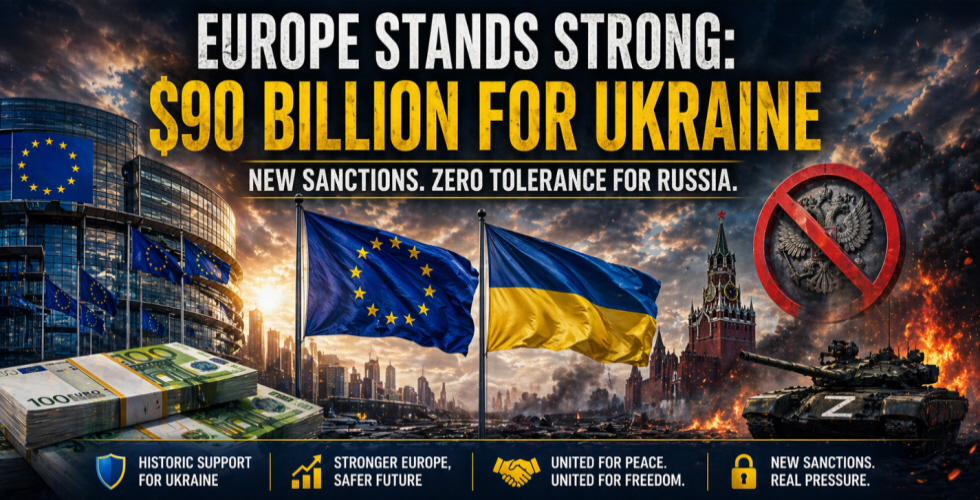
The European Union has moved forward with a major financial support package for Ukraine, reinforcing its long-term commitment to Kyiv as the war continues to reshape Europe’s security architecture. The decision follows months of internal disputes and reflects the bloc’s determination to maintain strategic pressure on Russia. At the same time, a new sanctions package against Moscow is also advancing. Brussels is sending a clear geopolitical message. The financial package, valued at tens of billions of euros, aims to stabilize Ukraine’s economy, sustain state functions and support long-term reconstruction.
European leaders consider financial continuity essential for Ukraine’s resilience on both the battlefield and the diplomatic front. The move represents one of the largest coordinated commitments since the conflict began. It is both economic support and political positioning. For months, the main obstacle came from Hungary, whose government delayed approval amid disputes linked to Russian oil supplies and broader energy security concerns. Prime Minister Viktor Orbán had tied his resistance to the sensitive issue of the Druzhba pipeline and the impact of restrictions on national interests. The disagreement exposed deep fractures inside the European bloc.
Energy and war remain inseparable. Despite these divisions, the majority of EU members pushed to move forward. Officials warned that delaying assistance would weaken Ukraine at a critical moment and send the wrong signal to Moscow. The final consensus reflects the belief that hesitation would be strategically more dangerous than economic cost. European unity, even under tension, ultimately prevailed. Alongside financial support, the European Union is also advancing a new sanctions package designed to further restrict Russia’s economic capacity. These measures target sectors linked to war financing, industrial supply chains and long-term military sustainability.
The objective is to reduce Moscow’s strategic flexibility while increasing diplomatic isolation. Economic pressure remains central to the Western response. Several European leaders have openly argued that sanctions must intensify as long as Russia refuses to halt military operations. The position reflects growing frustration across the continent over the prolonged conflict and its wider consequences. For many governments, economic pressure is seen as the only remaining peaceful tool with real impact. Patience inside Europe is becoming thinner.
Austria and other member states have publicly reaffirmed that supporting Ukraine is no longer only a moral issue, but a direct matter of European security. The war is increasingly viewed as a structural threat to the continent’s long-term stability. This perception has transformed financial aid into a strategic necessity rather than an optional gesture. The political tone has hardened.
As the war enters a deeper and more prolonged phase, Europe’s response is becoming more permanent and institutional. Aid packages, sanctions and military coordination are no longer temporary measures but part of a broader strategic transformation. The continent is adapting to a new geopolitical reality. Europe is preparing for a conflict whose consequences may define an entire generation.


