
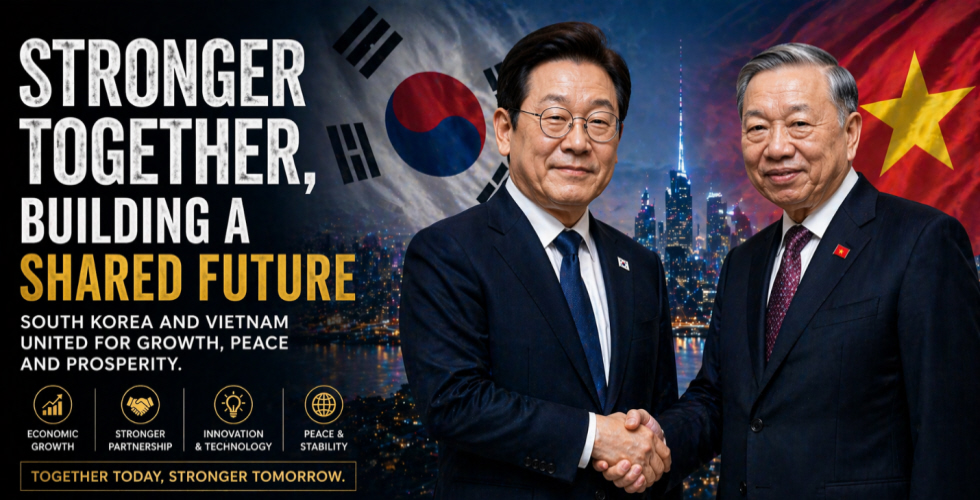
The visit of Lee Jae-myung to Vietnam marks an important move in Asia’s new geopolitical chessboard. His meeting with Tô Lâm was not simply a diplomatic gesture, but a clear signal that both nations seek to strengthen a strategic alliance in the middle of an increasingly competitive regional environment. Asia is redefining its balance, and Seoul wants to secure its position. Vietnam has become one of South Korea’s most valuable partners in trade, manufacturing, and technological expansion.
South Korean companies maintain a strong industrial presence in Vietnamese territory, especially in sectors such as semiconductors, electronics, and advanced production. This relationship not only generates investment, but also creates a network of economic stability that benefits both sides. Cooperation has already moved far beyond symbolism. During the meeting, both sides emphasized the need to deepen ties in innovation, investment, and regional development.
South Korea seeks to diversify its supply chains and reduce risks in an international context marked by trade tensions and strategic rivalries. Vietnam, for its part, uses that opportunity to strengthen its role as a key center in Southeast Asia. Geopolitics is also negotiated in factories and ports. The relationship between Hanoi and Seoul also carries a strong diplomatic component.
Vietnam maintains a policy of balance between major powers such as China and the United States, avoiding absolute alignments that could compromise its autonomy. South Korea understands that logic and seeks to strengthen its regional presence without creating unnecessary confrontation. Modern diplomacy demands precision more than noise. China watches these movements closely. Although Vietnam maintains complex relations with Beijing, it also seeks strategic alternatives that allow it to reduce dependence and expand its room for maneuver.
South Korea appears as an ideal partner: economically strong, technologically advanced, and politically influential without being a direct threat. That combination is especially valuable in the current environment. For Seoul, this visit also represents an opportunity to expand its influence beyond its traditional axis with Japan, China, and the United States. Southeast Asia has become a priority for its foreign policy, especially at a time when global competition demands new flexible alliances. Vietnam is not only a commercial partner; it is a gateway to a broader regional architecture.
The Asian map is changing rapidly. The official toast between both leaders reflects much more than diplomatic courtesy. Behind that image lies a long-term strategy that combines trade, regional security, and political projection. Twenty-first century alliances are no longer built only through military treaties, but through investment, technology, and mutual trust. Power is also measured in economic stability.
At a time when Asia concentrates much of the world’s geopolitical tension, every diplomatic gesture carries greater meaning. The relationship between South Korea and Vietnam shows that the regional future will not depend only on the traditional major powers, but also on smart alliances between middle actors. Seoul and Hanoi seem to understand that perfectly. Asia’s new balance is also being written through handshakes.


