
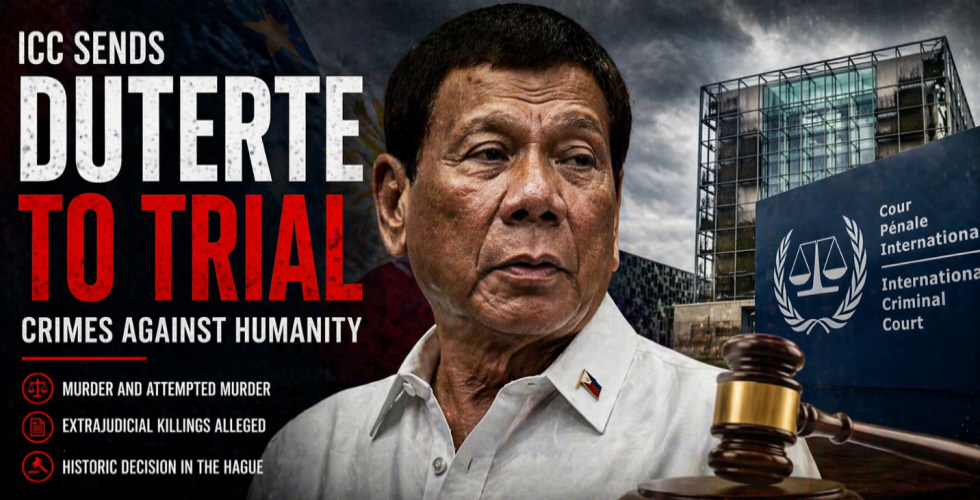
The decision by the International Criminal Court to send former Philippine president Rodrigo Duterte to trial marks one of the most significant international judicial processes of recent years. This is not simply a political case, but a formal accusation of crimes against humanity linked to his so-called war on drugs. The ruling opens a new stage in one of Asia’s most controversial legal files. International justice is entering a decisive phase. Judges at the International Criminal Court unanimously confirmed charges of murder and attempted murder, concluding that there are sufficient grounds to proceed to a full trial.
According to the prosecution, Duterte had direct responsibility in multiple extrajudicial killings committed during his time as mayor of Davao and later as president of the Philippines. The case is built on years of investigations and testimonies. Its judicial dimension goes far beyond political debate. During his presidency, the anti-drug campaign was presented as a national security policy aimed at fighting crime and narcotics trafficking. However, human rights organizations reported from the beginning thousands of deaths without due process, violent operations, and a systematic pattern of executions outside the legal framework.
The international image of the Philippines was deeply marked by those accusations. Now that past returns with legal weight. The ICC argues that these were not isolated incidents, but part of a structured policy with command responsibility. That point is central because it transforms individual abuses into a possible prosecution for crimes against humanity. The legal difference is enormous and places the case in a much more serious dimension. What is being judged is not only an administration, but a state strategy. Duterte has repeatedly rejected the accusations and still maintains political support among important sectors in the Philippines.
His defenders argue that the anti-drug campaign was a necessary response to a real security crisis and that ICC intervention represents foreign interference in sovereign national affairs. That narrative still holds strong influence inside the country. The legal battle will also be a battle over legitimacy. The trial in The Hague will also carry strong symbolic weight in international politics.
Very few former heads of state reach this stage inside the International Criminal Court, and each case redefines the real reach of global justice. The deeper question is whether national leaders can truly be held accountable for decisions taken under the argument of public security. The answer will shape future precedents. For the families of the victims, this decision represents a possibility of recognition that for years seemed impossible.
Beyond any future sentence, the fact that the case moves forward already serves as institutional validation of complaints ignored for a long time. International justice does not always arrive quickly, but its historical weight is often profound. Memory also needs courts. Publishing this story in the Justice section is not only appropriate, but necessary.
This case is not limited to Philippine politics or regional geopolitics; it speaks about the limits of power, the responsibility of rulers, and the reach of human rights during times of crisis. Duterte will now face not only legal judgment, but also the judgment of history. And both can be equally severe.


