
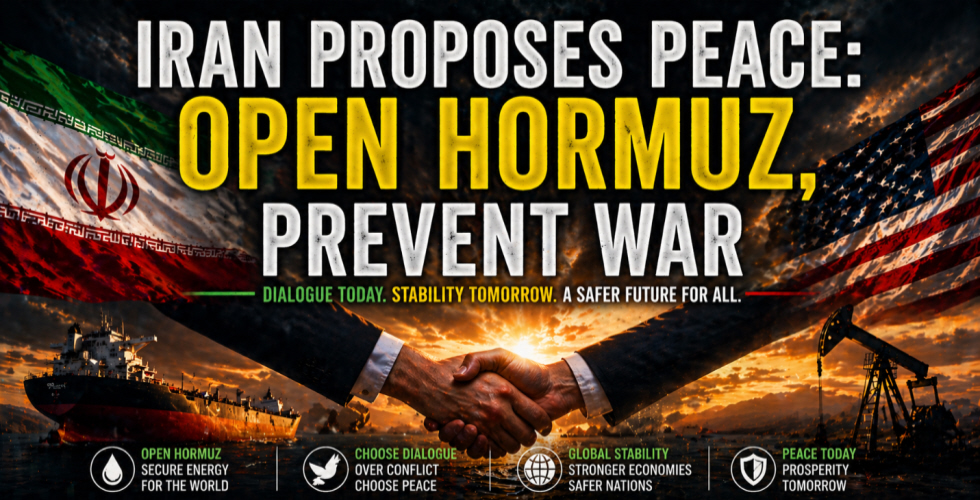
Iran has presented a new diplomatic proposal to the United States aimed at stopping the military escalation and facilitating the reopening of the Strait of Hormuz, one of the most strategic maritime routes on the planet. The initiative seeks to reduce immediate tension and prevent a greater impact on global energy trade. The move has drawn international attention because of its potential effect on regional stability and world markets. The Strait of Hormuz represents a critical point for the transit of oil and gas, and any threat to its operation generates an immediate reaction in the international economy.
In recent weeks, the possibility of disruptions pushed crude prices higher and increased concern across Europe, Asia, and the Americas. The full reopening of the maritime passage has become a major geopolitical priority. The Iranian proposal suggests a two-stage formula. First, an understanding to reduce military confrontation and guarantee free commercial transit in the area. Then, a second phase focused on more complex issues, including Iran’s nuclear program and the security guarantees demanded by Washington and its Western allies. Tehran believes that mixing all issues into a single negotiation would make real progress impossible.
That is why it is trying to separate economic urgency from the long-term strategic dispute. The immediate priority would be to avoid an international energy crisis that could affect not only the powers involved, but also countries that depend on a stable flow of hydrocarbons. From Iran’s perspective, reopening the Strait of Hormuz also requires a reduction in military and naval pressure in the region. The presence of international forces and threats of blockade have been interpreted by Tehran as a form of political coercion. Iran argues that any lasting solution must include a visible decrease in that operational pressure.
In Washington, the proposal was reviewed cautiously by Donald Trump’s national security team. The U.S. administration maintains its main position: any agreement must prevent Iran from preserving the capacity to develop nuclear weapons. For the White House, regional security cannot depend only on temporary commitments regarding maritime trade. Israel is also watching this new diplomatic move closely, as it believes that any easing of pressure on Iran must be accompanied by strict controls over its strategic program. Tel Aviv fears that a rushed negotiation could allow Tehran to gain time without truly changing its regional objectives.
That distrust remains one of the biggest obstacles to a broad agreement. Europe, for its part, is pushing for dialogue to move forward quickly. Germany, France, and Italy understand that a prolonged conflict could trigger a new wave of inflation driven by energy prices. For European economies, the stability of the Strait of Hormuz is not only a diplomatic matter, but an immediate economic necessity.
International markets reacted with moderate optimism to news of this new Iranian offer, although volatility remains present. Investors know that a proposal does not mean an agreement and that any diplomatic mistake can quickly reverse temporary calm. Oil continues to be the most visible thermometer of this global tension. The real dispute remains the same: who gives in first and under what conditions.
Iran proposes a gradual peace focused first on energy stability, while the United States insists on long-term strategic guarantees. Between these two approaches lies not only the future of the conflict, but also the political and economic balance of the entire region.


