
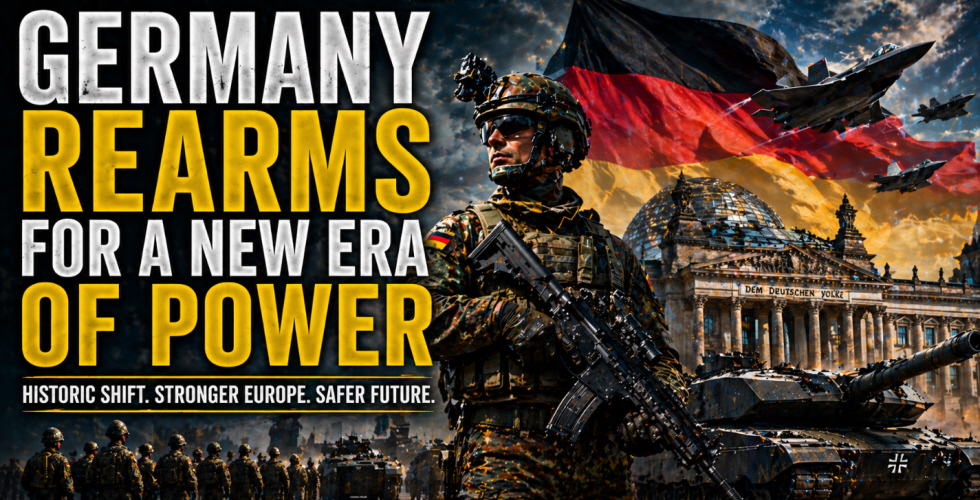
Germany is experiencing one of the deepest transformations in its recent history regarding security and defense. For decades, Berlin maintained a policy of military caution shaped by the historical weight of World War II and a strategic vision based on restraint. Today, that approach is changing rapidly and on a scale that is already redefining the balance of power in Europe. The new direction is not limited to a simple increase in military spending. It is a structural transformation that includes modern weaponry, expansion of active personnel, strengthening of military reserves, and the incorporation of new strategic technologies.
Berlin seeks to rebuild a defense capacity that for years was considered insufficient even within NATO. Hundreds of billions of euros are being directed toward this modernization process. Germany has raised its military spending to levels not seen in decades, even surpassing historic alliance targets. The investment includes air defense systems, cyber defense, drones, artificial intelligence, and a complete renewal of operational infrastructure. One of the central goals is to strengthen the Bundeswehr and significantly increase the number of available personnel. The plan includes a much stronger active force and a reserve capable of responding quickly to scenarios of continental crisis.
The priority is no longer only national defense, but also the ability to provide military leadership within Europe. Defense Minister Boris Pistorius has made it clear that Germany must prepare for a more unstable and dangerous international environment. The war in Ukraine, Russian pressure on Eastern Europe, and uncertainty about the long-term strategic commitment of the United States have completely changed Berlin’s perception of risk. Security has stopped being theory and has become political urgency. There is also an industrial and economic dimension to this restructuring.
Germany’s defense industry is once again becoming a national priority, generating billion-dollar contracts, specialized jobs, and technological alliances with other European partners. Security is no longer analyzed only from the military front, but also from the perspective of productive sovereignty. For many years, Germany was criticized for depending too heavily on the American military umbrella while maintaining a posture that was more economic than strategic. Today, that reality is being corrected quickly. Berlin understands that European leadership cannot be sustained only with financial power, but also with real defense capacity and military decision-making.
This change generates support, but also internal debate. Part of German society views any military expansion with caution because of deep historical reasons. The memory of the past remains a sensitive factor in national politics. However, the new political generation argues that current threats require decisions that once seemed unthinkable. At the international level, German rearmament changes the entire architecture of European security.
France, Poland, the United Kingdom, and the Baltic countries are closely watching this new phase, aware that a militarily stronger Germany changes the continental dynamic. The message is clear: Berlin no longer wants to be only Europe’s economic engine, but also one of its main strategic shields. What is happening is not a temporary adjustment, but a historic redefinition of Germany’s role in the world. Germany is leaving behind decades of military moderation to enter a new era of strategic responsibility. The real question is no longer whether Berlin will rearm, but how far it is willing to go in its new ambition for European power.


