
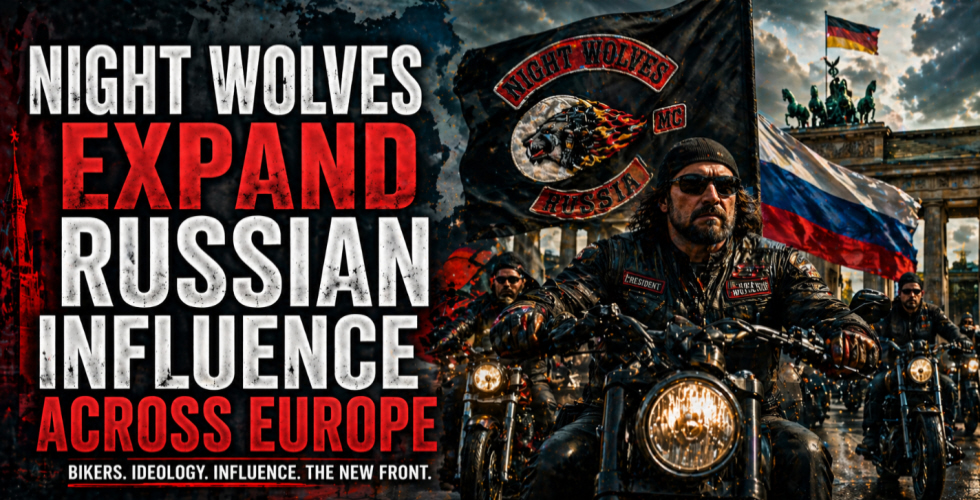
The Russian motorcycle club known as the “Night Wolves” is once again drawing international attention because of its growing presence and influence in several European countries, especially Germany. The organization, known for its close ties to the Kremlin and to Vladimir Putin, claims that its popularity continues to grow even in territories considered politically distant from Moscow. That statement has reopened the debate over its true role within Russian geopolitics.
The Night Wolves are not seen merely as a traditional motorcycle club. For years, they have been associated with a nationalist, Orthodox Christian, and openly pro-Kremlin narrative linked to the concept of the so-called “Russian world.” Their leader, Alexander Zaldostanov, known as “The Surgeon,” maintains a public and symbolic relationship with Putin, making the group far more than a cultural or recreational organization. In Germany, representatives linked to the club claim that more and more citizens are showing interest in moving closer to this ideological vision.
Although there are no independent official figures confirming such growth, the group insists that even in countries with critical positions toward Russia, there is a rising wave of sympathy. That narrative is used as a sign of resistance against what they describe as anti-Russian propaganda. One of the most visible events of this expansion is the international motorcycle tour called “Roads of Victory,” organized to commemorate the anniversary of the end of World War II.
This mobilization has been used for years as a symbolic tool of political presence and historical memory. It is not simply a caravan, but a demonstration of ideological and territorial identity. European authorities are watching these activities with caution. Some members of the group have been subject to international sanctions because of their public support for the annexation of Crimea and Russia’s military offensive in Ukraine. In addition, several countries have imposed travel restrictions, police monitoring, and public debate over the true purpose of their international movements.
In Germany, the issue carries special sensitivity because of the historical and political significance of any movement related to World War II and Russian influence in Eastern Europe. The possibility that groups with strong symbolic and political weight could expand their presence raises concerns among security and intelligence sectors. The fear is not limited to propaganda, but also to possible links with more complex influence networks.
Accusations of alleged ties to espionage or mafia structures have circulated for years, although they are not always accompanied by conclusive public evidence. However, the group’s reputation has already been deeply shaped by that international perception. For critics, the Night Wolves represent an informal extension of the Kremlin’s soft power; for supporters, they are defenders of Russian identity and patriotic tradition.
Beyond the controversy, the phenomenon shows how international influence is no longer exercised only through embassies or formal institutions. It can also advance through symbols, culture, social movements, and groups with strong narrative power. In that field, the Night Wolves have become a unique instrument within Russia’s broader strategy of political projection across Europe.


