
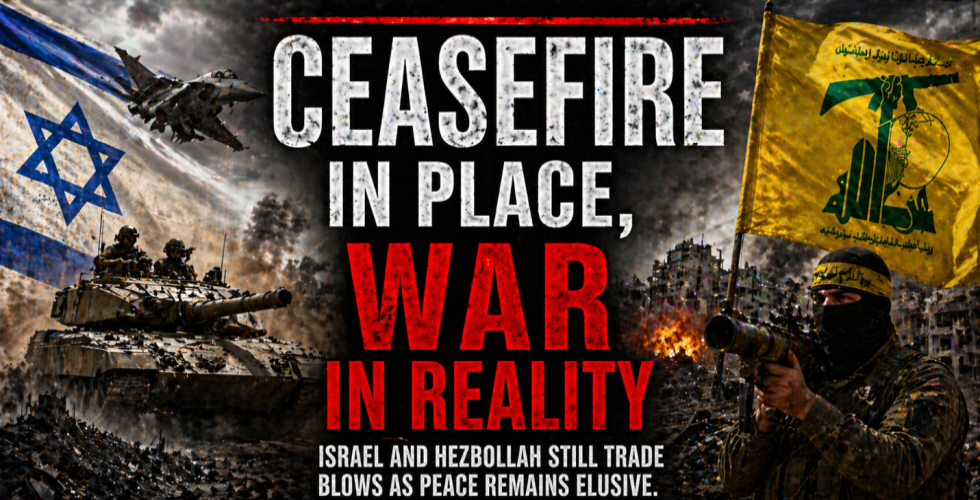
The ceasefire between Israel and Hezbollah in southern Lebanon remains officially in force, but on the ground the reality shows a much more fragile situation. Although the internationally mediated agreement sought to reduce military escalation, exchanges of attacks, bombings, and surveillance operations continue to occur almost daily. Peace exists more on paper than on the border. Israel argues that it is maintaining preventive operations to stop Hezbollah from rearming and to neutralize immediate threats near its northern border.
From Tel Aviv, officials insist that national security cannot depend only on diplomatic promises while movements considered hostile continue. That position has justified new targeted strikes even during the active ceasefire period. Hezbollah, for its part, believes that the agreement has lost meaning while Israeli military actions continue inside and near Lebanese territory. Leaders of the group have described the ceasefire as insufficient and even empty of substance if there is no real reduction in military pressure. The militia insists it will not accept a one-sided peace under constant fire.
In this context, the Shiite organization has reaffirmed a position it has maintained for years: rejecting any direct negotiations with Israel. Its leadership argues that establishing formal talks would be an unacceptable political concession and a betrayal of its ideological and strategic line. For Hezbollah, the conflict cannot be resolved through direct diplomatic recognition. This position contrasts with the vision of the Lebanese government, which seeks to reduce tensions and open channels that could prevent a new regional war.
From Beirut, officials believe that moving toward mechanisms of stability does not mean surrender, but rather an urgent necessity to protect the economy and avoid an even greater institutional collapse. The country is under enormous internal pressure. The Lebanese president and moderate sectors understand that a prolonged escalation with Israel would have devastating consequences for a nation already hit by economic crisis, political fragility, and social exhaustion. The possibility of reconstruction depends largely on preventing the southern border from once again becoming an open war front. Diplomacy appears as a necessity rather than an option.
However, Hezbollah maintains enormous political and military influence inside Lebanon, making it difficult to impose a completely different national strategy. Its armed capacity and territorial weight turn every decision about regional security into a complex internal negotiation. The Lebanese state does not fully control the pace of the conflict.
The result is an extremely unstable balance where the ceasefire formally survives, but the possibility of a new regional explosion remains very real. Between daily attacks, Israeli warnings, and Hezbollah’s refusal to negotiate directly, the border continues to be one of the most dangerous points in the Middle East. The truce exists, but the war has never fully disappeared.


