
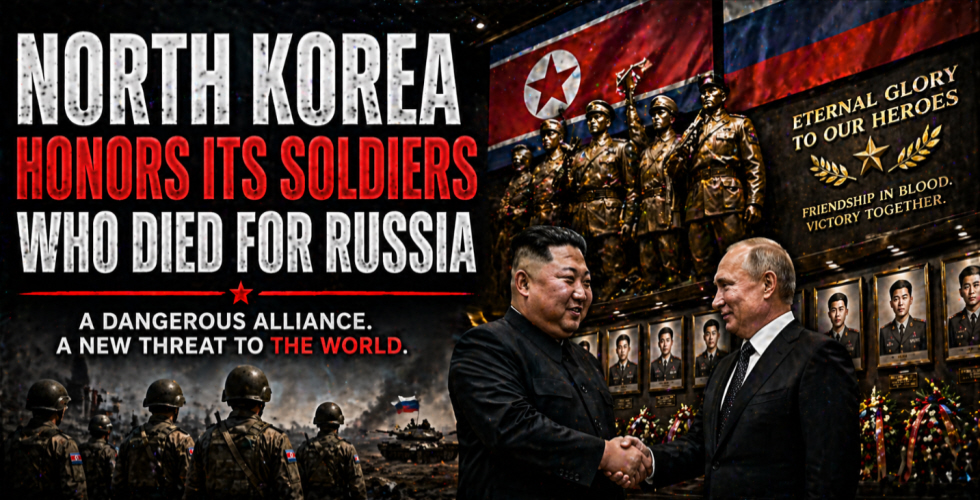
North Korea has taken a new symbolic and political step in its alliance with Russia by opening a memorial museum dedicated to North Korean soldiers who died fighting alongside Russian forces in the war against Ukraine. The ceremony took place in Pyongyang with strong propaganda symbolism and the presence of senior officials from both countries. The message was clear: military cooperation between Moscow and Pyongyang is no longer hidden. The museum especially honors the fighters sent to Russia’s Kursk region, where Ukraine had managed border incursions during critical stages of the conflict.
In April 2025, both Russia and North Korea officially acknowledged that North Korean troops participated in joint operations to contain those advances. It was the first public confirmation of direct military collaboration between the two governments. Although neither country has released full official figures, South Korean intelligence estimates that Pyongyang deployed around 15,000 soldiers. Of that total, nearly 2,000 are believed to have died in combat, a significant number that reflects the real level of North Korean involvement in the European war. The scale of that sacrifice reinforces the political weight of the memorial.
Kim Jong Un presented those soldiers as national heroes and symbols of international revolutionary commitment. For the North Korean leadership, the narrative aims to strengthen internal legitimacy and show that North Korea is not isolated, but actively participating in the defense of a strategic ally against the West. External war also becomes a tool of internal cohesion. From Moscow, Vladimir Putin sent a message of support highlighting the “strategic friendship” between both nations and praising the sacrifice of the North Korean fighters.
Russia is not only seeking political backing, but also concrete military cooperation at a time when the war in Ukraine continues to demand enormous human and logistical resources. Pyongyang appears as a useful and willing partner. Western analysts are watching this development with growing concern. The direct participation of North Korean troops in real combat could significantly transform the military experience of Kim’s army, especially in modern artillery operations, drones, and electronic warfare. Battlefield learning may have future consequences on the Korean Peninsula.
There is also concern about a possible technological exchange between Moscow and Pyongyang. North Korea could receive assistance in missiles, satellite systems, air defense, or nuclear capabilities in exchange for its military support. That scenario would alter not only the European balance, but also strategic security in East Asia, especially for South Korea, Japan, and the United States.
Beyond the museum, the real message lies in the formalization of an open military alliance between two governments openly opposed to the West. This is no longer about diplomatic support or symbolic declarations, but about dead soldiers, operational cooperation, and promises of future integration. In the new global geopolitical architecture, Russia and North Korea are making it clear that their relationship has entered a new phase.


