
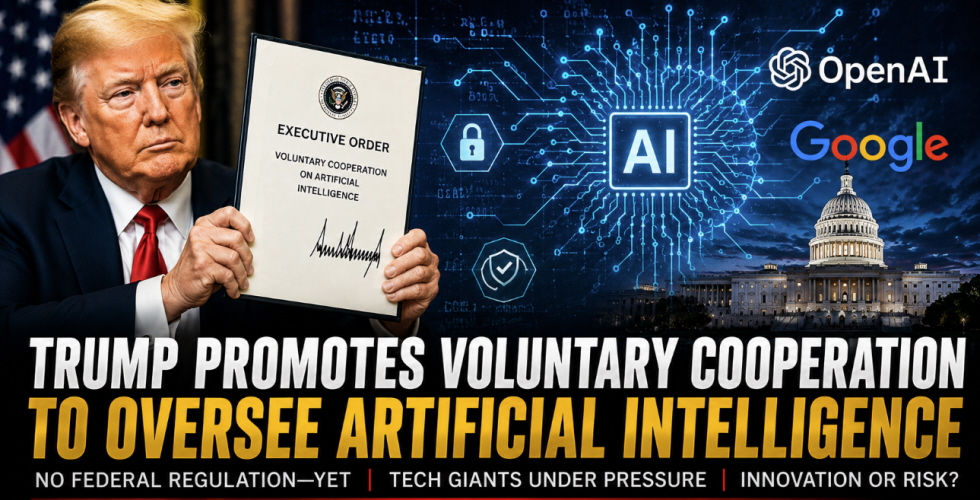
Artificial intelligence continues to advance rapidly across the United States while the debate over regulation remains unresolved. Despite repeated warnings from security, privacy, and technology experts, the federal government has yet to establish a comprehensive framework governing the development of AI systems. Against this backdrop, Donald Trump signed an executive order in Washington encouraging major technology companies to cooperate voluntarily with federal authorities. The initiative seeks to promote information sharing and safety standards without imposing new mandatory regulations on the industry.
The effort is aimed at leading AI developers, including OpenAI and Google, whose technologies are used daily by millions of people worldwide. These companies remain at the forefront of developing increasingly sophisticated AI models capable of generating text, images, software code, and other forms of digital content. Supporters of a flexible approach argue that excessive regulation could slow innovation and weaken America's competitive position in the global technology race. They believe collaboration between government and industry can produce faster and more adaptable solutions than strict legislation.
Critics, however, warn that voluntary commitments may not be sufficient. Many cybersecurity and ethics specialists argue that AI systems have the potential to influence critical economic, social, and political processes, requiring stronger oversight and accountability mechanisms. Among the primary concerns are misinformation, deepfake technology, personal data protection, and the potential impact of automation on employment. Experts have also expressed concern about the use of advanced AI systems in military and national security applications. Several lawmakers have proposed creating specialized agencies to monitor and evaluate AI development.
However, political disagreements and the complexity of the technology have made it difficult to establish a unified federal regulatory structure. Meanwhile, technology companies continue investing billions of dollars into AI research and development. The race to lead the next generation of artificial intelligence has become a strategic priority for both governments and private corporations.
The administration's emphasis on voluntary cooperation highlights the challenge of balancing innovation with public safety and accountability. Policymakers must weigh economic opportunities against the potential risks associated with increasingly powerful technologies. For now, the United States is relying heavily on collaboration between government and industry. Whether this approach proves effective may determine how the country manages one of the most transformative technological revolutions of the modern era.

