
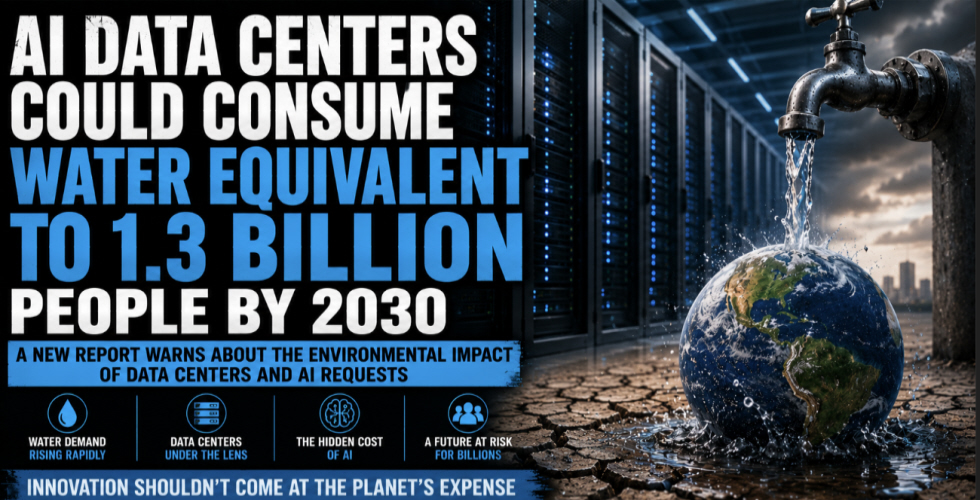
The rapid expansion of artificial intelligence is raising new questions about its environmental impact. While millions of people use AI-powered tools for work, education, and communication, experts are increasingly examining the resources required to sustain this technological revolution. Among the growing concerns is the amount of water consumed by large-scale data centers. The debate is intensifying as demand for digital services continues to rise. Data centers are facilities that house thousands of servers responsible for processing information around the clock.
These systems generate substantial amounts of heat and require cooling technologies to operate safely and efficiently. In many cases, cooling processes depend heavily on water usage. As a result, the growth of digital infrastructure is also increasing demand for water resources. Various projections suggest that water consumption associated with artificial intelligence could rise significantly over the coming years. As AI models become more sophisticated and user numbers continue to grow, processing requirements expand as well. Every request, analysis, and content generation task requires computing power. While each individual interaction may seem small, the cumulative global impact is substantial.
The rapid development of artificial intelligence has encouraged major technology companies to build new data centers in different regions of the world. These facilities require billions of dollars in investment and highly reliable infrastructure to maintain continuous operations. In addition to energy consumption, water use has become an increasingly important issue. Some local communities have begun questioning the environmental impact of these projects. Experts emphasize that artificial intelligence offers significant benefits for economic growth, scientific research, and productivity. At the same time, they argue that technological progress should be accompanied by sustainable development strategies. The challenge is to balance innovation with responsible resource management.
Every technological breakthrough carries responsibilities that must be carefully considered. One aspect that has sparked discussion is the suggestion that users reduce unnecessary interactions with AI systems in order to minimize computing demand. Some analyses argue that millions of additional queries create a cumulative burden on servers. However, many specialists believe that the effect of individual actions is relatively small compared to the overall infrastructure requirements. The debate has highlighted the complexity of the issue. Beyond specific recommendations, attention is increasingly focused on improving the efficiency of data centers themselves.
Technology companies are investing in advanced cooling systems and innovative solutions designed to reduce water consumption. Researchers are also exploring renewable energy integration and more efficient operational methods. The goal is to lower the environmental footprint of future digital infrastructure. Governments and regulatory agencies are beginning to pay closer attention to the growth of the sector. In some regions, policymakers are evaluating regulations related to the use of natural resources by large technology facilities.
Greater transparency regarding water and energy consumption is becoming an increasingly important public issue. Growing public interest may accelerate future policy changes. At the same time, researchers are working to develop more efficient artificial intelligence models. Reducing the amount of computing power required for training and operation has become a major priority across the industry.
Every improvement in efficiency has the potential to lower costs and reduce environmental impact. Innovation and sustainability are becoming closely connected goals. Artificial intelligence is expected to continue transforming many aspects of modern life in the decades ahead. However, its expansion also requires careful consideration of the resources that make this technology possible.
The challenge is not only to create more powerful systems but also to ensure that their growth remains sustainable. Finding the right balance between innovation and environmental responsibility will be essential for the future of the digital age.

