
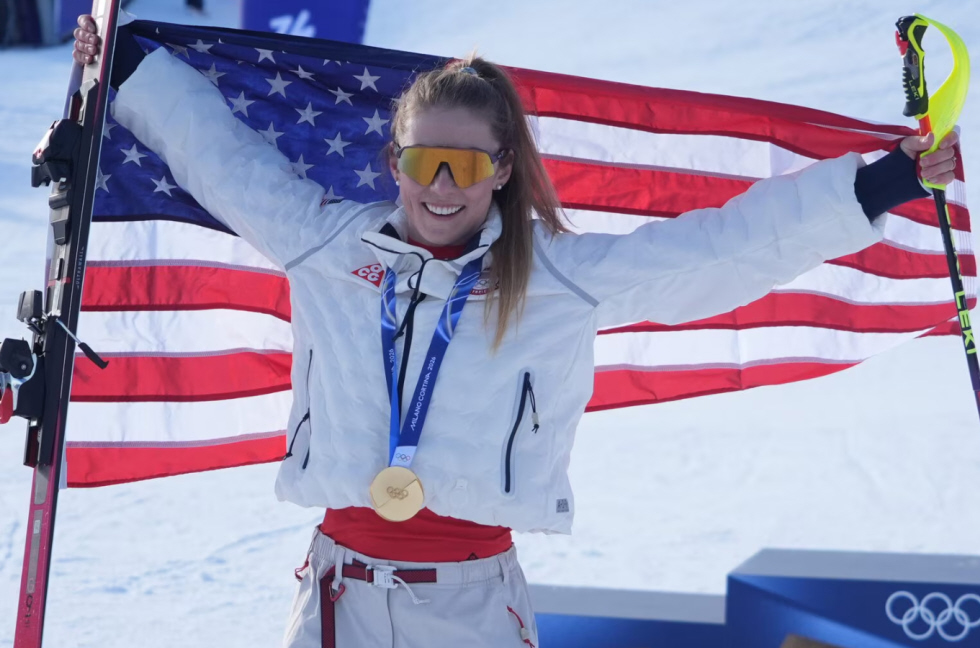
Mikaela Shiffrin has finally brought an end to her eight-year Olympic medal drought, delivering a decisive performance in the women’s slalom at the 2026 Winter Games in Italy. The alpine skiing icon once again proved why she remains one of the sport’s most respected figures. Prior to this breakthrough, Shiffrin had competed in eight consecutive Olympic events without reaching the podium — an unusual stretch for an athlete accustomed to dominating World Cup circuits and global championships.
Expectations were high, but so was the pressure. Her Olympic campaign did not begin smoothly. In the combined team event finals, she and teammate Breezy Johnson finished sixth after what was considered one of the least consistent slalom runs of her career. The struggles continued in the giant slalom, where Shiffrin placed eighth, raising questions about her competitive rhythm early in the Games.
However, in the individual slalom, the American skier rediscovered her precision and technical sharpness. From the opening run, she displayed greater control and confidence compared to her earlier performances. In the decisive second run, she executed a clean and aggressive descent that allowed her to climb crucial positions on the leaderboard, securing her long-awaited return to Olympic hardware.
The medal carries emotional weight beyond the result itself. In recent years, Shiffrin has faced injuries, personal challenges, and intense public scrutiny, making this achievement particularly meaningful. Her ability to respond under pressure reinforces her status as a defining figure in modern alpine skiing and a symbol of resilience in elite sport.
With this performance, Shiffrin reclaims her place at the center of Olympic competition, reminding the world that even the greatest champions must sometimes navigate adversity before returning to glory. As the 2026 Winter Games continue, Shiffrin’s redemption story already stands out as one of the most compelling narratives of the tournament.
 Boston Celtics
 Denver Nuggets
 Milwaukee Bucks
 Phoenix Suns
 Golden State Warriors
 Los Angeles Lakers
 Miami Heat
 Dallas Mavericks


