
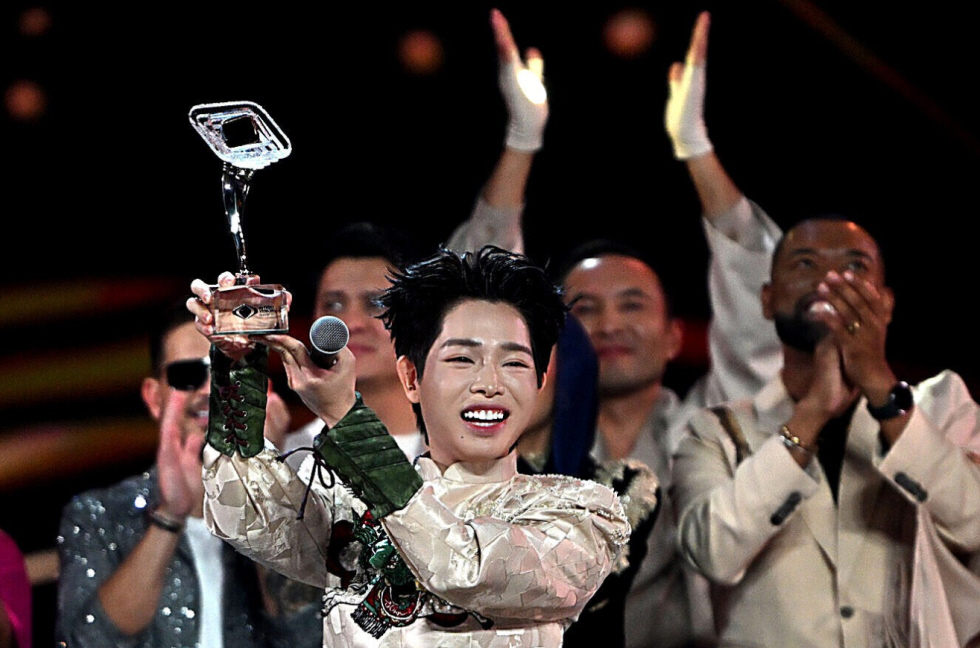
Russia has already been banned from participating in the Eurovision Song Contest four times due to its war of aggression against Ukraine. In response, President Vladimir Putin organized his own counterevent in Moscow: the International Intervision Music Contest, which brought together more than 20 countries and even featured an American rock star on the jury. The winner of this first edition was Vietnamese artist Duc Phuc, who was crowned after a gala that, in many aspects, mirrored the European format.
The competition bore a striking resemblance to Eurovision: musical clips, sofas for artists during the waiting periods, a dynamic alternation between stage performances and interviews, and technically sophisticated digital stage sets. However, it lacked certain key elements such as public voting and the distinctive spirit of diversity that defines the ESC. This was not accidental, as Moscow intended to distance itself from the European contest, which was criticized by Russian officials as being “colorful and gay-friendly.
” Before the event, Russian Foreign Minister Sergei Lavrov had promised that there would be “no perversions or mockery of human nature,” stressing that the goal was to “respect the original destiny of mankind and its identity in free contacts.” Nevertheless, Kremlin propaganda was strongly present. In front of some 11,000 spectators at Moscow’s Live Arena, Putin framed the competition as the revival of the Soviet-era Intervision and presented it as part of a culture supposedly free from Western dominance.
Among the participants were several former Soviet republics such as Belarus, Kazakhstan, and Uzbekistan, as well as BRICS allies including China, India, Brazil, and South Africa. For the global television audience, the broadcast was delivered in Russian, Chinese, and English, reinforcing the Kremlin’s attempt to portray the event as international. Russia was represented by ultranationalist singer Yaroslav Dronov, known as Shaman, with his song “Direkt ins Herz.
” A fervent supporter of both the invasion of Ukraine and of Putin himself, he is best known for the nationalist anthem “Ja Russki” (“I am Russian”), released shortly after the start of the war. Following his performance, Shaman shouted the slogan loudly into the microphones and asked the jury not to evaluate his entry since he was representing the host country.
The event was not without controversy. Just minutes before the scheduled performance of Australian-born singer Vassy (Vasiliki Karagiorgos), who had been announced as representing the United States, the organizers declared that she would not take part after all, citing “unprecedented political pressure from the Australian government.” Despite her absence, the United States was still represented on the jury by rock singer Joe Lynn Turner, former member of Deep Purple, adding an international presence to what was clearly designed as a political and cultural challenge to Eurovision.


