
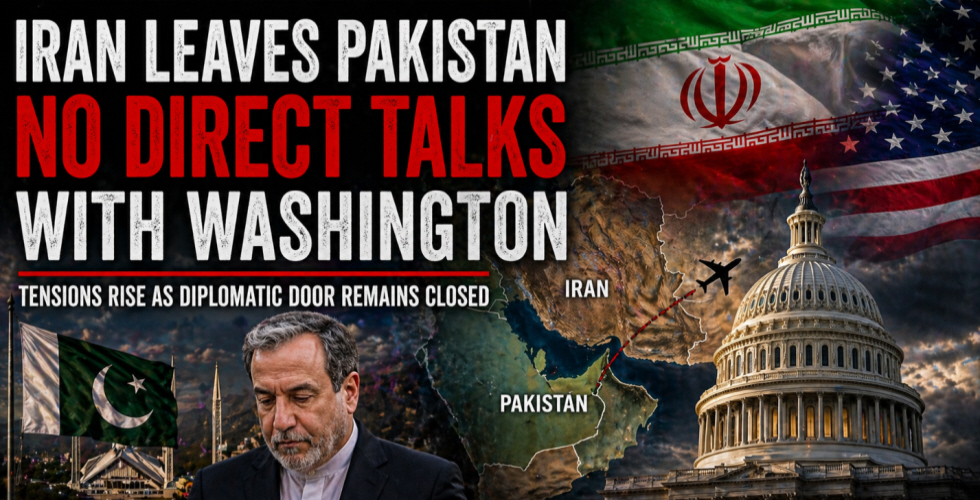
Diplomatic tensions between the United States and Iran escalated once again after it was confirmed that there would be no direct meeting between representatives of both countries in Pakistan. What had initially been seen as a possible opportunity to revive dialogue quickly lost momentum. The absence of American negotiators and the departure of Iran’s foreign minister marked another setback in an already fragile and distrust-filled process. Iranian Foreign Minister Abbas Araghchi arrived in Islamabad on Friday as part of a regional agenda that sparked speculation about a possible meeting with U.S. envoys.
Several international media outlets had suggested that Pakistan’s capital could become a stage for indirect diplomacy between the two powers. However, Tehran moved quickly to cool expectations from the very beginning. The spokesperson for Iran’s Foreign Ministry made it clear that no meeting with the American side was planned. According to official statements, Araghchi’s visit was focused exclusively on bilateral matters between Iran and Pakistan, particularly border security, economic cooperation, and regional stability. The clarification aimed to stop interpretations that spoke of secret negotiations promoted by third parties.
From Washington, the White House had hinted at the possibility of sending representatives to explore a new diplomatic channel. The names of Steve Witkoff and Jared Kushner circulated as possible envoys for discreet conversations on Pakistani soil. However, President Donald Trump’s administration ultimately chose not to move forward with the trip, avoiding a meeting that was already surrounded by skepticism. The decision not to send negotiators reflects the difficult political moment between both nations, especially after months of heightened tension in the Middle East.
Differences over Iran’s nuclear program, Tehran’s regional influence, and economic sanctions remain the main obstacles to any serious rapprochement. Neither side appears willing to make public concessions on issues considered strategically vital. Pakistan, meanwhile, had emerged as a possible quiet mediator due to its functional relations with both Iran and the United States. Islamabad maintains a delicate diplomatic balance in a region marked by deep rivalries and overlapping conflicts. Its geographic and political position allows it to act as a bridge, although without guarantees of success when dealing with such deeply opposed actors.
Araghchi’s departure from Islamabad without any contact with U.S. officials was interpreted as a clear sign that there was no real foundation for progress. Analysts believe Tehran wants to avoid any image of negotiating under pressure, especially in a domestic context where maintaining a firm stance against Washington remains a source of political legitimacy. Keeping distance also strengthens its internal narrative. Trump, for his part, continues to maintain a hardline position toward Iran, reinforced by his electoral rhetoric and his strategic vision for the Middle East.
His administration insists that any dialogue must produce concrete results rather than symbolic gestures. This approach leaves little room for informal negotiations, especially while both sides continue to deeply distrust each other. The failure of this possible contact in Pakistan also sends a message to other regional actors closely watching relations between Washington and Tehran. Countries such as Saudi Arabia, Israel, and Turkey follow every diplomatic movement because any change could alter the strategic balance of the entire region. Uncertainty only fuels further tension in an already highly sensitive environment.
For now, the diplomatic channel remains practically frozen, while public signals continue to be dominated by caution and indirect confrontation. Araghchi’s visit ended without the outcome many had expected, and the American absence confirmed that no immediate progress is on the horizon. Once again, diplomacy remains trapped between distrust, strategy, and global geopolitical pressure.


