
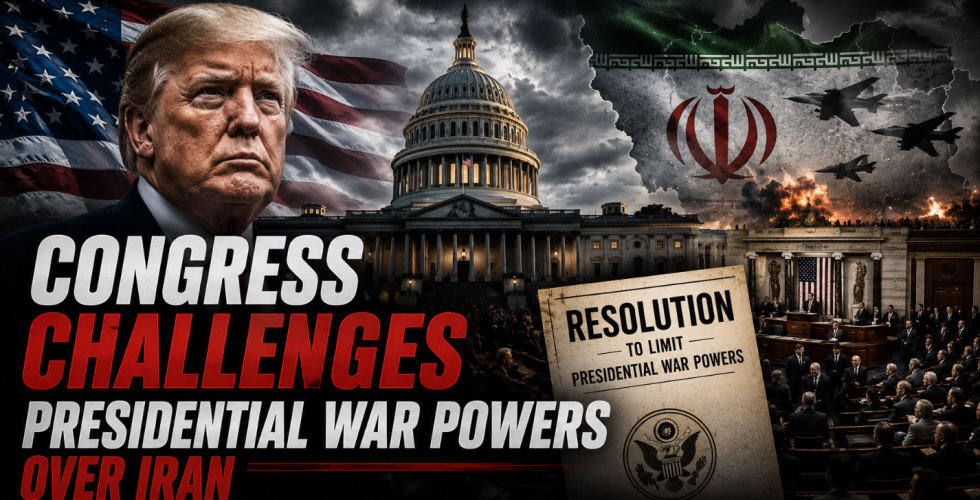
Growing political tensions inside United States over the conflict involving Iran are now opening a new battle within Washington itself. Members of Congress and the Senate are increasingly questioning military decisions pushed forward by Donald Trump and the true scope of presidential war powers during extended international conflicts. The controversy centers primarily around the duration and expansion of military operations, as well as the constitutional authority of the president to continue prolonged warfare without explicit approval from Congress.
Several lawmakers argue that the institutional balance of power could be weakened by unilateral decisions involving foreign policy and national defense. In response to the growing political backlash, U.S. senators introduced a resolution designed to limit presidential powers in military conflicts that extend beyond specific time limits. The debate revives long-standing constitutional arguments regarding Congress’ role in authorizing and supervising overseas wars. For decades, the United States has experienced intense internal disputes over prolonged military interventions in different regions of the world.
Conflicts such as Iraq and Afghanistan left deep political divisions concerning the human, economic, and strategic costs associated with long-term military engagements. Several lawmakers warn that the current situation involving Iran could rapidly escalate into a much broader Middle Eastern conflict. Because of that risk, some political sectors believe it is essential to strengthen congressional oversight mechanisms before regional tensions evolve into another extended war.
Meanwhile, the White House continues defending the need to preserve strategic flexibility in response to international threats. Officials close to the administration argue that the president must maintain the ability to react quickly in highly complex and rapidly changing military situations. The dispute also reflects deep divisions inside Washington regarding the direction of American foreign policy.
Some political groups support a tougher stance toward Iran, while others believe diplomatic opportunities still exist and have not yet been fully explored by the administration. Constitutional experts argue that the crisis once again places the limits of presidential authority at the center of American political debate. The tension between national security and legislative oversight has remained one of the most delicate and controversial issues within modern U.S. democracy. International analysts are also closely monitoring the political confrontation because any major shift in American strategy could directly affect Middle Eastern stability.
Decisions made in Washington carry immediate consequences for regional allies, global energy markets, and international security dynamics. Although no final consensus has yet emerged inside Congress, the growing political clash demonstrates that the conflict involving Iran is no longer only an international issue. It is increasingly becoming an institutional and constitutional struggle within the American political system itself.


