
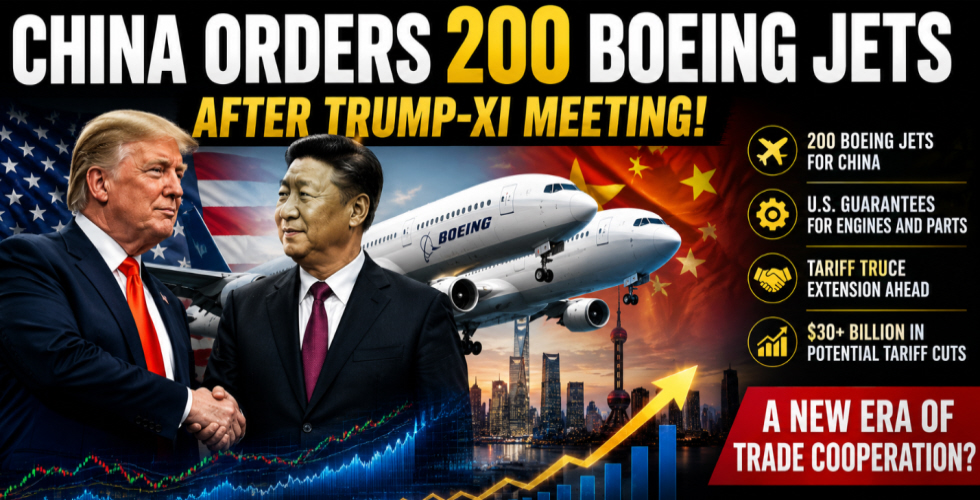
The confirmation that China will purchase 200 aircraft from Boeing represents one of the most significant commercial agreements between Washington and Beijing in recent years. The announcement came shortly after the meeting between Donald Trump and Xi Jinping in Beijing, immediately drawing strong attention from global financial markets. The agreement also includes U.S. supply guarantees for aircraft engines, parts, and key aviation components destined for the Chinese market.
This reflects not only a massive commercial transaction, but also a strategic effort to stabilize industrial supply chains that have been heavily affected by years of political and economic tensions between the two powers. The news was welcomed positively by investors and market analysts because of its direct impact on Boeing and the broader American aerospace industry.
The company has faced several difficult years marked by production problems, rising global competition, and restrictions linked to geopolitical disputes and trade uncertainty. Beyond the aviation deal itself, both governments also confirmed they will work toward extending the tariff truce previously negotiated between the two countries. Discussions additionally include possible tariff reductions on more than 30 billion dollars worth of goods, a move that could ease pressure on global trade and manufacturing sectors.
Over the last several years, economic relations between the United States and China experienced a period of intense confrontation driven by sanctions, technology restrictions, and escalating trade wars. However, this latest development appears to signal that both governments are seeking to avoid a deeper economic conflict that could further damage global stability. International observers believe the agreement strategically benefits both sides. China secures access to essential aircraft technology needed for its rapidly expanding aviation sector, while the United States strengthens one of its most symbolic industries amid increasing competition from European and Asian manufacturers.
The aerospace sector remains one of the most influential industries in the global economy because of its enormous impact on employment, technological innovation, and international supply chains. For that reason, any agreement of this scale between Washington and Beijing carries immediate consequences far beyond the aviation market itself. Analysts are also viewing the deal as an important political signal directed toward Wall Street and international investors.
The meeting between Trump and Xi projects an image of economic pragmatism and dialogue at a time when the global economy continues facing uncertainty, inflation concerns, and slowing international trade growth. Meanwhile, the possibility of additional tariff reductions is creating optimism among exporters, manufacturers, and multinational corporations that depend heavily on commercial exchanges between the world’s two largest economies.
Many industries believe that more stable relations between Washington and Beijing could significantly reduce global financial risks. Although major geopolitical differences still exist between the United States and China, the Boeing agreement demonstrates that both governments understand the strategic importance of maintaining key economic channels open. In an increasingly divided world, commercial cooperation remains one of the few areas still capable of temporarily bringing the two global superpowers together.


