
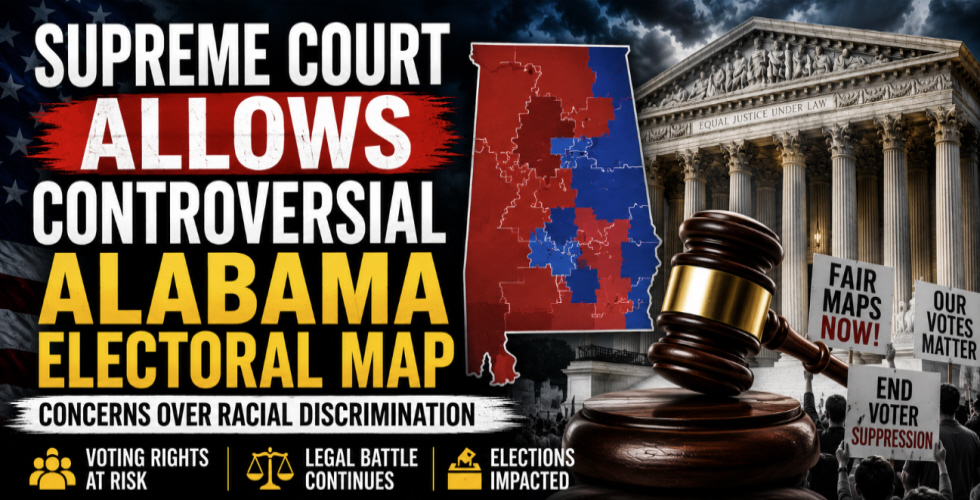
The U.S. Supreme Court has temporarily allowed the use of a controversial electoral map in Alabama, a decision that could influence political representation in the state during upcoming elections. The ruling represents a significant victory for Republicans who support the redistricting plan. The decision has reignited a national debate over voting rights and electoral fairness. Civil rights groups have expressed concern about its potential impact. At the center of the controversy is the redrawing of congressional districts that determine how representatives are elected to Congress. Critics argue that the new map reduces the ability of Black voters to influence election outcomes.
According to voting rights advocates, the plan could weaken the political representation of historically marginalized communities. These concerns have led to multiple legal challenges in federal courts. Lower federal courts had previously questioned the legality of the map approved by Alabama officials. Some judges concluded that there were indications of racial discrimination in the way the districts were designed. However, the Supreme Court chose to temporarily lift those restrictions while legal proceedings continue. This decision allows the map to remain in place for future elections pending further review.
Supporters of the redistricting plan argue that the state acted within its constitutional authority when reorganizing the districts. They maintain that the changes are based on legitimate legal and demographic considerations and reject claims of racial discrimination. They also contend that decisions regarding electoral boundaries should primarily remain under state control. In their view, excessive judicial intervention could disrupt the balance of government powers.
On the other hand, civil rights organizations view the ruling as a setback for voter protections. They argue that the redistricting plan could limit the ability of minority communities to elect candidates of their choice. These groups emphasize that fair representation is a cornerstone of American democracy. As a result, they have pledged to continue fighting the issue through the courts. The dispute comes at a time when several states are facing similar battles over electoral maps and political boundaries.
Both Republicans and Democrats have historically been involved in redistricting efforts that generate controversy. Cases involving racial representation, however, tend to attract greater public attention because of their broader social implications. Alabama has once again become a focal point in that national debate. Election law experts say the case could influence future redistricting disputes across the country. The legal standards applied to protect minority voters may serve as a benchmark for other states facing similar challenges. In addition, the final outcome could affect how federal voting rights laws are interpreted and enforced.
For these reasons, the case is being closely watched by political observers. The decision may also have important consequences for upcoming congressional elections. Depending on how voters are distributed within the new districts, some seats could become more favorable to one political party. This could ultimately affect the balance of power in the U.S. House of Representatives. Both major parties are carefully monitoring the potential electoral impact. The Supreme Court did not issue a final ruling on the merits of the case. Instead, it temporarily allowed the map to be used while appeals and legal arguments continue.
This means the broader legal battle is far from over. Additional court decisions could still alter the situation in the months ahead. The issue is expected to remain a major political and legal topic. For now, the ruling represents a provisional victory for Alabama officials and supporters of the new electoral map. At the same time, it leaves unresolved concerns about representation, equality, and voting rights. The final outcome could have consequences that extend well beyond Alabama’s borders. The case highlights how redistricting remains one of the most sensitive issues in American politics today.


