
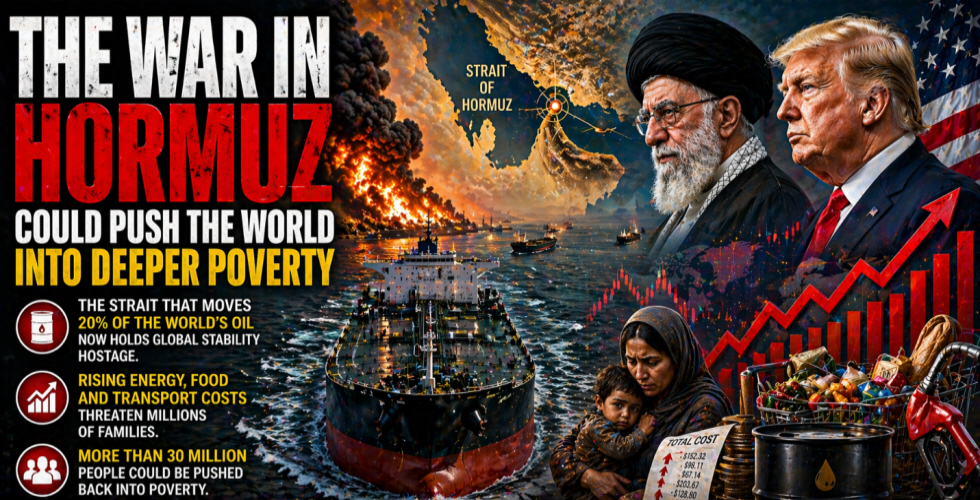
The war surrounding Iran and the growing tension in the Strait of Hormuz no longer represent only a regional Middle East crisis. Its consequences are beginning to spread across the global economy, affecting energy, food, trade, and social stability on different continents. What happens in that maritime corridor can redefine the lives of millions of people far beyond the Persian Gulf. The impact has already moved far beyond the military sphere. According to estimates from the United Nations Development Programme, more than 30 million people could fall back into poverty as a direct consequence of this crisis.
The warning is not limited to oil prices, but to the domino effect it creates on fertilizers, transportation, agricultural production, and access to basic goods. When energy becomes more expensive, the entire global economic structure suffers. Poverty also travels through maritime routes. The Strait of Hormuz is one of the most sensitive points on the planet because nearly twenty percent of the world’s oil passes through it. Any disruption in that route immediately affects international markets and creates fear among governments, corporations, and central banks. Even the mere threat of closure causes financial turbulence.
A full-scale war is not necessary to trigger a global crisis. Iran has increased pressure in the area through naval operations, vessel detentions, and public warnings about its strategic control of the strait. The sharp reduction in maritime traffic has raised alarms among the world’s main energy-consuming powers. Every ship delayed means higher costs, logistical setbacks, and new diplomatic tensions. Global trade depends on corridors that now appear dangerously fragile. The United States responded by raising both military and political pressure.
Donald Trump announced that any attempt to place mines in the area would be met with direct attacks against the responsible vessels. Washington considers keeping the maritime passage open a matter of international security, not only economic interest. The warning seeks deterrence, but it also increases the risk of escalation. Europe and Asia are watching this scenario with particular concern. Countries highly dependent on imported oil could face accelerated inflation, rising industrial costs, and growing domestic social pressure. The most fragile economies would be the first to feel the blow. When energy prices rise, so do the costs of food, transportation, and everyday life.
The conflict becomes domestic. Global agriculture also enters the equation. Fertilizers, fuel, and logistics chains are deeply connected to energy stability. If supply is disrupted, agricultural production declines and food prices surge. Nations with fewer resources to respond face the greatest humanitarian risk. Hunger often arrives after the energy crisis, not at the same time. International analysts warn that this situation has already begun to erase a significant part of the global economic growth expected for the year.
The estimated reduction in world output is not an abstract number, but a real signal of slowdown for employment, investment, and financial stability. Markets react quickly, but social consequences arrive later and hit much harder. Economies take longer to recover than to fall. Beyond the immediate military confrontation, the real challenge is preventing a geopolitical crisis from becoming a massive humanitarian disaster.
International diplomacy now faces the responsibility of containing the conflict before the damage becomes irreversible. This is not only about ships or oil, but about millions of families who could lose basic stability. Modern war is also measured in poverty. The Strait of Hormuz has become the clearest symbol of how one geographic point can alter the balance of the entire planet.
Through it flows not only oil, but also the stability of markets, governments, and entire societies. If that flow breaks, the consequences will be felt from Asia to Latin America. The world is once again discovering that geopolitics is also written in the price of bread.

