
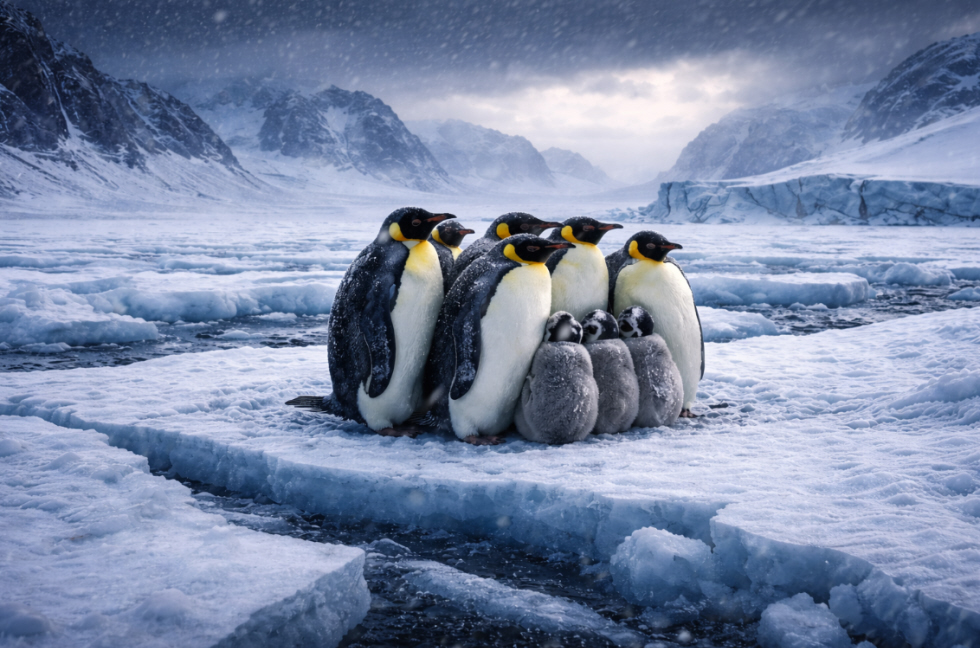
Climate change is creating increasingly complex consequences in Antarctica, and one of the species most affected is the emperor penguin. Although global temperatures continue to rise, these birds are facing a growing risk of death from freezing conditions. The apparent contradiction has a biological and environmental explanation.
During their molting period, emperor penguins temporarily lose the waterproofing and insulation provided by their feathers, leaving them especially vulnerable to extreme cold. At this critical stage, penguins cannot enter the ocean to feed because their new plumage is not yet fully developed. Instead, they rely entirely on stable sea ice to remain sheltered and protected from the frigid Antarctic waters.
Historically, vast stretches of sea ice provided secure platforms where penguins could gather in large groups to conserve heat. These tightly packed formations are essential for survival in one of the harshest climates on Earth. However, climate change has significantly reduced and fragmented these ice platforms. The areas where penguins can safely complete their molt are becoming smaller, thinner, and less stable.
When sea ice breaks apart prematurely, penguins may be forced into contact with freezing water before their feathers have fully regrown. In such conditions, exposure to icy water can quickly become fatal. The shrinking ice also disrupts natural grouping behavior. Emperor penguins depend on dense clustering to retain warmth, but limited space reduces their ability to form protective formations.
Scientists warn that these shifts affect not only immediate survival rates but also long-term population stability. Colonies that lose adults during molting may experience declining reproductive success in future breeding seasons. The situation illustrates how global warming does not always produce simple or intuitive outcomes.
In polar ecosystems, even subtle temperature changes can dramatically alter ice dynamics and wildlife survival patterns. As Antarctica continues to warm and sea ice becomes increasingly unpredictable, the future of emperor penguin colonies may depend on how global climate trends evolve in the coming decades.


