
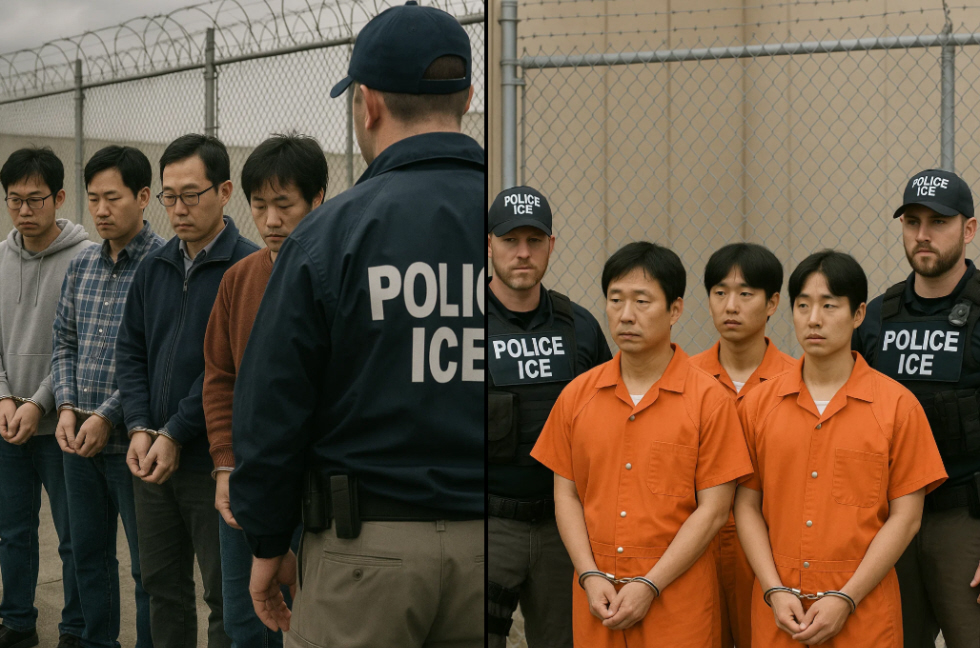
The administration of U.S. President Donald Trump has carried out another large-scale immigration raid, this time at a Hyundai Motor construction site in the state of Georgia, threatening to open a serious diplomatic rift with South Korea, one of Washington’s closest allies in Asia. According to initial reports, approximately 475 workers were arrested, with estimates suggesting that at least 300 are of South Korean origin.
The operation, led by U.S. immigration authorities, targeted workers accused of having entered the country illegally or overstaying expired visas. The incident immediately triggered alarm in Seoul. South Korean President Lee Jae Myung ordered the implementation of comprehensive measures on Saturday to protect his citizens, though he did not mention them explicitly. Meanwhile, Foreign Minister Cho Hyun expressed his “deep concern” during an emergency cabinet meeting and announced that he would travel to Washington to hold talks with Trump administration officials if necessary.
“I have a great responsibility toward our detained citizens and I am deeply worried about this situation,” Cho said, confirming the creation of a crisis team to monitor developments closely. The political and diplomatic impact is potentially severe. South Korea is not only a strategic ally in the region—key in the ongoing competition between the United States and China—but also a critical investor in the U.S. economy. Both countries are currently negotiating the details of a trade agreement involving $350 billion in South Korean investments, seen as a cornerstone of Washington’s policy to strengthen supply chains and reduce reliance on China.
The construction site where the raid occurred is part of a Hyundai Motor plant being developed in partnership with LG Energy Solution, a leading battery manufacturer. The company confirmed that 47 of its employees and roughly 250 subcontracted workers were among those detained. As an immediate response, LG Energy Solution announced it was suspending all business travel to the United States, except for client meetings, signaling the growing corporate and diplomatic strain. International analysts warn that the incident could become a serious point of contention in bilateral relations.
For Seoul, the mass detention of its citizens represents not only a humanitarian issue but also a threat to the future of joint investments. For Washington, the operation is part of Trump’s “zero tolerance” immigration policy, but the diplomatic cost could be significant if the matter is not handled with care. The situation adds a new layer of complexity to U.S.-South Korea relations, in a regional context already defined by rivalry with China, delicate trade negotiations, and the importance of securing supply chains in strategic industries such as automotive manufacturing and energy.


