
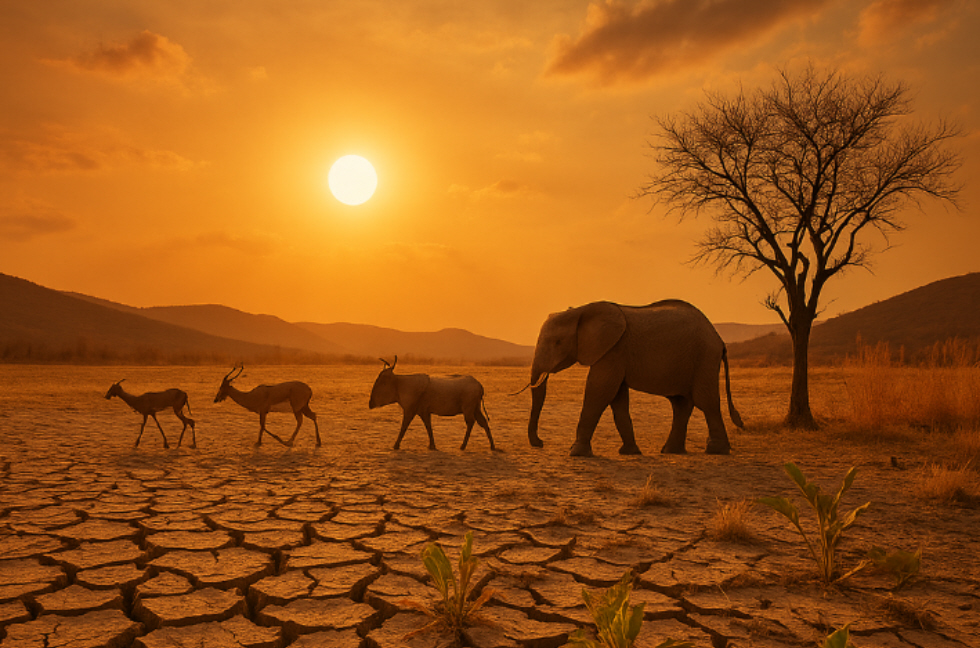
Europe is facing an escalating environmental crisis: intense heat waves and prolonged droughts are devastating agriculture, straining water resources, and pushing economic losses to critical levels. Farmers in Germany report crop reductions of between 40% and 75% due to dry fields, while in the United Kingdom and Spain, wildfires and heat stress have risen alarmingly.
The direct economic impact has already reached nearly €43 billion this year, a figure that could climb to €126 billion by 2029 when indirect losses in tourism, productivity, and infrastructure are factored in. A new global report on extreme heat reveals that between May 2024 and May 2025, approximately 4 billion people—nearly half of the world’s population—experienced at least 30 days of extreme heat, defined as temperatures above the historical 90th percentile for each region.
In 195 territories, climate change doubled the frequency of these heat waves. In many countries, days of extreme heat have been at least twice as frequent as they would have been without human influence. Climate predictions are equally concerning: there is a 70% probability that the average temperature between 2025 and 2029 will exceed 1.5°C above pre-industrial levels.
Moreover, there is an 80% chance that at least one of those years will be hotter than 2024, which already stands as the warmest year on record. These figures point to an accelerating trend in global warming, with stronger impacts on heavy rainfall, ice melt, sea level rise, and multiple extreme weather phenomena. The economic toll is already visible.
A report from Allianz warns that heat waves could shave up to 0.5 percentage points off Europe’s growth in 2025. In Spain, some regions could see GDP declines of up to 1.4 percentage points due to the prolonged heatwave. In response, experts and authorities are calling for stronger adaptation measures: better water management, investment in heat-resistant crops, reinforcement of power grids, raising public awareness on protection against extreme heat, and coordination across meteorological, health, and agricultural agencies.
The conclusion is clear: climate change is no longer a distant threat but a present reality with tangible impacts on life, the economy, and ecosystems. Action can no longer be delayed—the world must accelerate its transition to sustainable and resilient practices in order to confront this rapidly evolving climate scenario.


