

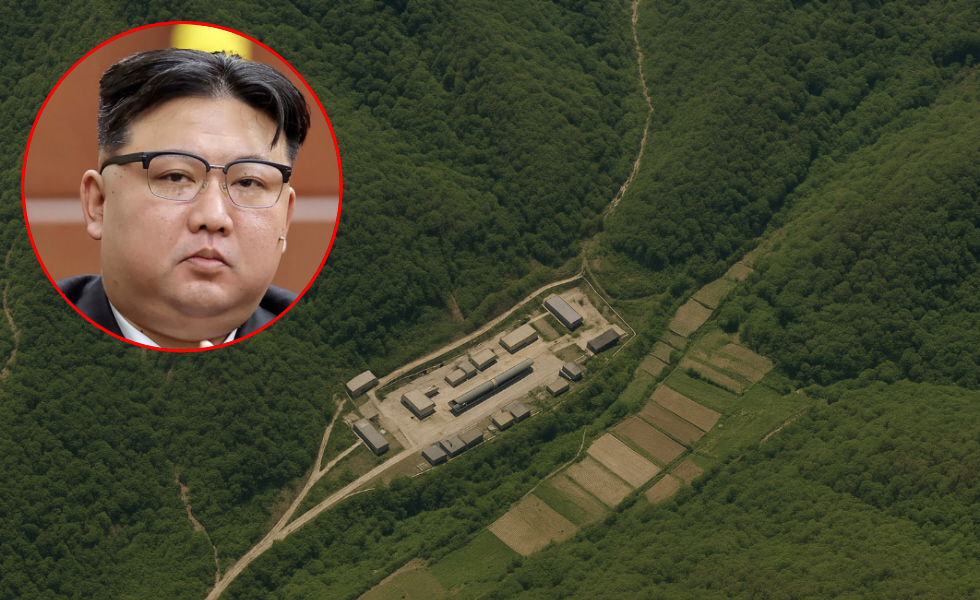
North Korea has secretly built a missile base in the Sinpung-dong area, a mountainous valley in North Pyongan Province, near the border with China. The base remains absent from official records and has never been mentioned in denuclearization processes.
According to reports from the Center for Strategic and International Studies (CSIS), the facility has been operational since at least 2014 and is believed to house between six and nine Hwasong-15 or Hwasong-18 intercontinental ballistic missiles — both nuclear-capable and with ranges sufficient to strike U.S. territory.
The strategic location of the complex, hidden among hills and reinforced with underground bunkers, provides military advantages by enabling secure storage of warheads, reducing the risk of preemptive strikes, and allowing rapid deployment in the event of conflict.
Experts warn that this base is part of a broader network of 15 to 20 similar undeclared facilities, highlighting Pyongyang’s deliberate strategy of concealment and reinforcing the perception of a growing threat in the region.
In addition, its proximity to China — less than 30 kilometers away — adds a layer of geopolitical complexity, as any attack on the base could be perceived as a direct risk to Chinese territory, further escalating tensions in East Asia.
International analysts stress that this revelation raises the alert level amid increasing military cooperation between North Korea, China, and Russia, representing a direct challenge to global arms control efforts and international security.


