
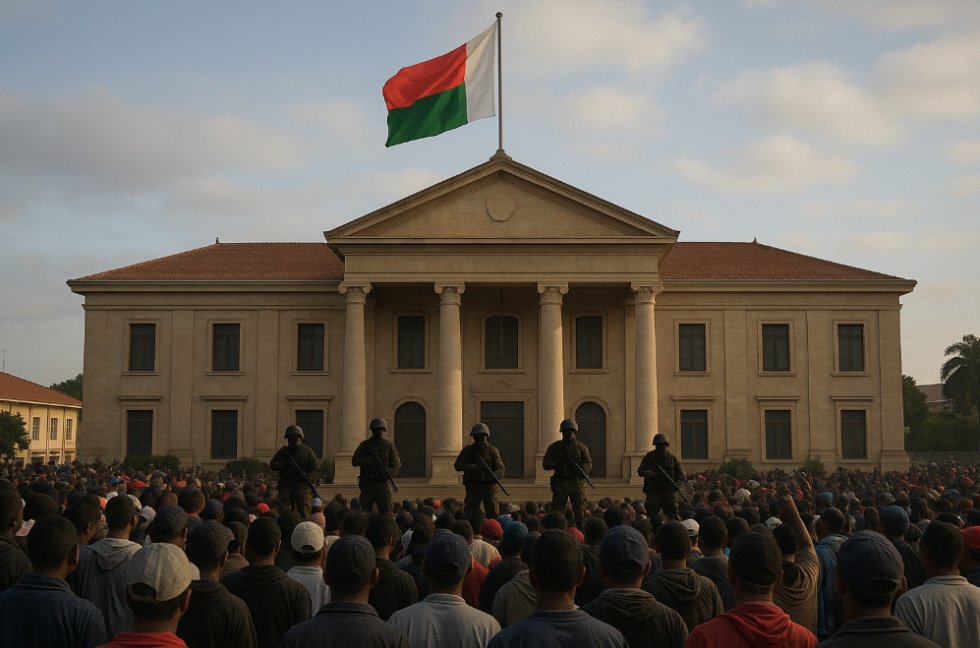
Madagascar is undergoing an open institutional rupture after weeks of protests that began on September 25 over power cuts lasting more than twelve hours and water shortages. The demonstrations—driven largely by young people with limited prospects—grew in size and intensity. In this context,
President Andry Rajoelina left the country and tried to dissolve parliament to block an impeachment vote. The chamber nevertheless voted against him, a decision the presidency branded illegal. After that, the elite unit CAPSAT, led by Colonel Michael Randrianirina, took control. The military announced the suspension of the Constitution, the dissolution of the Senate and the Supreme Constitutional Court, and the creation of a council composed of the armed forces and the police.
According to their statement, that council will appoint a prime minister to head a civilian government, while the National Assembly will continue to function. The junta says its goal is to restore order and organize the transition. The human toll of the crisis is severe. According to the UN, at least 22 people have been killed and more than one hundred injured, while the government has put the figure at twelve, whom it described as “looters” and “thieves.
” Looking ahead, the transition remains uncertain. Immediate challenges include containing violence, restoring basic services (electricity and water), setting a timeline for the prime minister and cabinet, and establishing verification mechanisms over the use of force and the protection of legislative activity. One of Africa’s poorest countries thus enters a delicate chapter.
Success will hinge on three factors: calm in the streets, minimum services restored, and a verifiable roadmap toward an operational civilian government. Without those pillars, the transition risks stalling and deepening the social crisis.


