
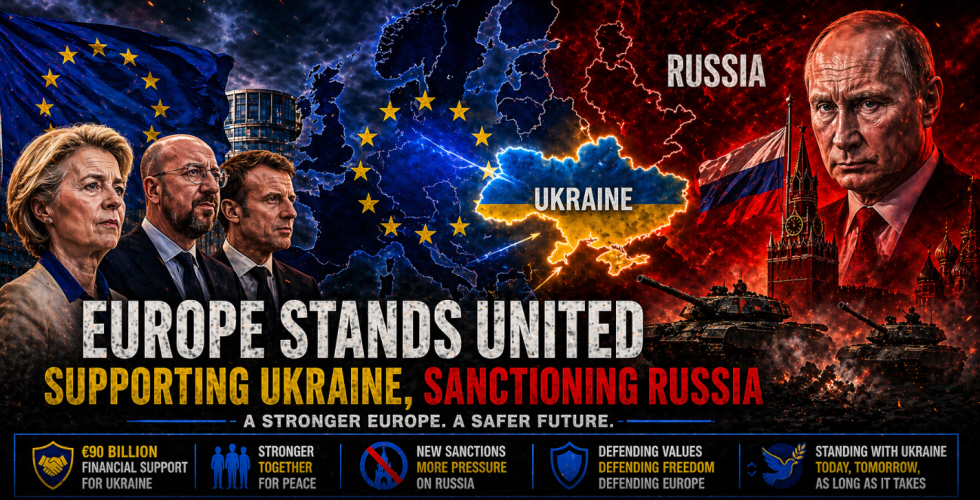
The European Union has moved forward with a major financial support package for Ukraine after months of internal disputes over energy policy and military assistance. The decision marks a significant political step in maintaining long-term backing for Kyiv. At the same time, new sanctions against Russia have also been advanced. Brussels is reinforcing both financial and strategic pressure. The support package represents one of the largest commitments approved by European institutions since the beginning of the conflict. Its objective is to help stabilize Ukraine’s economy, sustain essential state functions and reinforce reconstruction efforts.
European leaders view financial continuity as critical for Kyiv’s resilience. The move sends a strong message of commitment. At the center of the debate had been strong resistance from Hungary, whose government delayed approval for months. Prime Minister Viktor Orbán linked his position to broader disputes over Russian oil supplies and EU energy policy. The disagreement exposed deep divisions within the bloc. Energy and geopolitics remain tightly connected. The dispute was closely tied to the Druzhba pipeline, one of the key routes for Russian-linked oil flows into Central Europe.
Hungary argued that restrictions affecting these supplies would directly impact national energy security. This created a difficult negotiation inside the EU framework. Compromise required both political and economic balancing. Despite resistance, the broader consensus among EU members favored moving forward. European officials stressed that delaying assistance would weaken Ukraine’s position at a critical moment. The approval reflects a strategic calculation that long-term stability requires immediate support. Unity, even if fragile, was ultimately preserved. Alongside the financial package, the new sanctions package aims to increase pressure on Moscow’s economic capacity.
Restrictions target strategic sectors linked to war financing and military sustainability. The intention is to reduce Russia’s room for maneuver while reinforcing diplomatic isolation. Sanctions remain a central instrument of EU policy. The decision also carries symbolic value beyond economics. It demonstrates that despite internal disagreements, the European Union remains committed to collective security and regional stability.
Supporting Ukraine has become both a political and strategic principle. The bloc is signaling that fatigue will not define its response. As the war continues to reshape Europe’s security architecture, these decisions underline a broader transformation. Financial aid, sanctions and military coordination are becoming permanent features of EU policy. The continent is adapting to a prolonged geopolitical confrontation. The balance of Europe is being rewritten in real time.

