
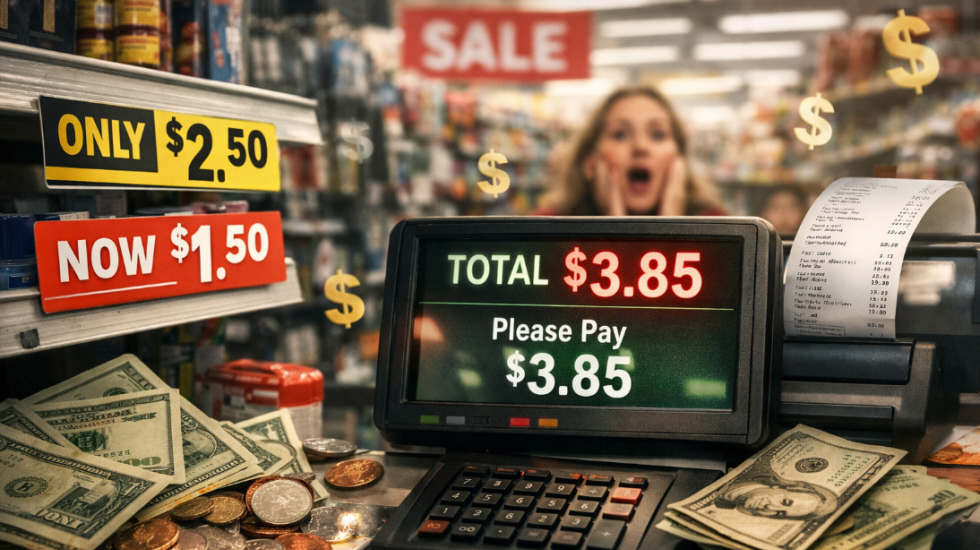
Utah lawmakers have approved a new law that significantly increases penalties for retailers who charge customers more at the register than the price displayed on store shelves. The measure comes in direct response to growing concerns and investigative findings that exposed widespread pricing discrepancies in major discount chains. The law is set to take effect on May 6, 2026, and aims to strengthen consumer protection. Its primary goal is to curb a practice that quietly impacts thousands of families on a daily basis. The issue at the center of the legislation is more common than many consumers realize: items marked at one price on the shelf but ringing up at a higher cost at checkout.
While the difference per item may seem small, it can accumulate into a significant financial burden over time. In many cases, shoppers either fail to notice the discrepancy or choose not to challenge it. This has allowed the practice to persist with limited accountability. The investigation that triggered legislative action revealed troubling data about pricing accuracy in major retail chains. Dollar General, one of the largest players in the discount retail sector, recorded more than 4,300 failed price inspections across 23 states between 2022 and 2025. Meanwhile, Family Dollar reported over 2,100 failed inspections in 20 states during the same period.
These figures suggest a consistent pattern rather than isolated incidents. Government inspections have shown that in some locations, a substantial portion of products displayed incorrect pricing. In one Utah store, nearly half of the items reviewed were found to have discrepancies between shelf prices and register charges. Such findings point to deeper structural issues in pricing management and inventory control systems. They also raise serious questions about corporate accountability. Until now, existing penalties have proven insufficient to deter these practices. Fines previously reached up to $5,000 per violation, but many companies treated them as a routine cost of doing business.
As a result, the enforcement lacked the necessary impact to drive meaningful change. The new law seeks to alter that dynamic by significantly increasing financial consequences. Under the updated legislation, penalties can rise to as much as $10,000 per violation, particularly for repeat offenders starting from the sixth documented infraction. Lawmakers expect that this sharper increase will compel companies to reassess their internal pricing controls. The goal is to incentivize better compliance through stronger financial pressure. Retailers may now be forced to invest more heavily in monitoring systems and staff training. The broader economic context adds urgency to the issue.
At a time when inflation continues to strain household budgets, even minor overcharges can have a disproportionate impact on consumers. Discount stores, which primarily serve cost-conscious shoppers, are at the center of this concern. This transforms the issue from a technical violation into a broader economic and social challenge. Experts argue that not all pricing discrepancies are intentional, as operational challenges can contribute to errors. Staffing shortages, outdated systems, and rapid inventory turnover are often cited as contributing factors.
However, when discrepancies become frequent and widespread, the explanation of simple error becomes less convincing. At that point, the issue shifts toward corporate responsibility. Utah’s decision could influence regulatory approaches in other states. Given that similar pricing issues have been documented across multiple regions, lawmakers elsewhere may consider adopting comparable measures. This could lead to a broader tightening of consumer protection laws nationwide.
The ripple effects of this legislation may extend well beyond state borders. Ultimately, the new law represents a clear effort to restore fairness and transparency in retail pricing. It sends a strong message that accurate pricing is not optional but essential to maintaining consumer trust. In an economy where every dollar matters, ensuring that customers pay what they see is a fundamental principle. Without that trust, the integrity of the market itself is at risk.

