
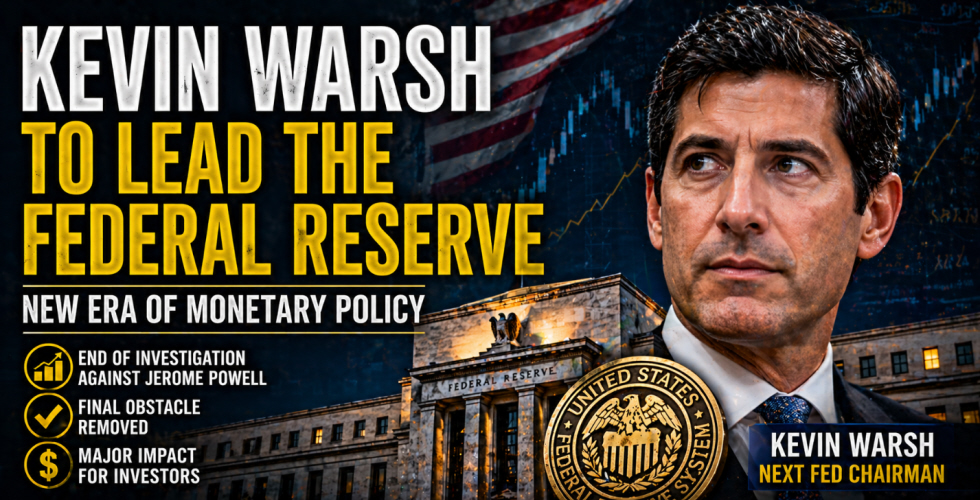
U.S. monetary policy is entering a decisive moment with the imminent arrival of Kevin Warsh as chairman of the Federal Reserve. His possible appointment marks a major shift for international markets, central banks, and investors around the world. This is not simply an institutional replacement, but a strong signal about the future economic direction of the world’s largest economy. For months, Jerome Powell’s continuity was surrounded by political uncertainty and public pressure. Criticism over the internal management of the Federal Reserve and the investigation related to renovation costs at the Fed’s headquarters created doubts about leadership stability.
With the closure of that process, the landscape changed and the path for a clearer transition was opened. Kevin Warsh now emerges as the central figure of this new phase. A former Federal Reserve governor with a long background in economic policy and financial markets, his name immediately draws attention on Wall Street. His profile is seen as closer to a vision of monetary discipline combined with greater sensitivity toward economic growth and market reactions. For investors, the arrival of a new Fed chair does not simply mean an administrative change.
It signals a possible shift in strategy regarding interest rates, inflation control, liquidity, and banking regulation. Every word spoken by the Federal Reserve can move bonds, stocks, currencies, and global expectations within minutes. One of the most closely watched issues will be Warsh’s position on interest rate cuts. While some sectors of the market expect a more flexible policy to stimulate growth, others fear that premature cuts could reignite inflationary pressure. The balance between price stability and economic momentum will be the major test of his leadership.
There is also an unavoidable political dimension to this transition. Many analysts see Kevin Warsh as a figure more aligned with Donald Trump’s economic vision, especially regarding the relationship between monetary policy and strategic national growth. That perception creates expectations, but also concerns about the true independence of the institution. The Federal Reserve has historically defended its autonomy as one of the pillars of international confidence in the U.S. financial system.
Any sign of direct political interference can generate nervousness among institutional investors and foreign central banks. The Fed’s credibility is worth as much as its technical decisions. Markets react not only to actions, but also to signals. A Warsh presidency could mean a more aggressive tone against inflation or, on the contrary, greater openness to faster adjustments in favor of growth. That initial uncertainty often translates into volatility, especially in sensitive sectors such as technology, banking, and energy.
At the international level, Federal Reserve decisions impact far beyond the United States. Latin America, Europe, and Asia closely watch every change because the dollar, the cost of credit, and capital flows depend directly on that policy. What happens in Washington affects companies, governments, and families across the entire world.
The possible arrival of Kevin Warsh at the Fed ultimately represents far more than a simple succession of names. It is a signal of where the U.S. economy may be heading in the coming years. For the markets, the real question is not only who will lead the institution, but which economic vision will dominate the new monetary era of the United States.

