
What happened.
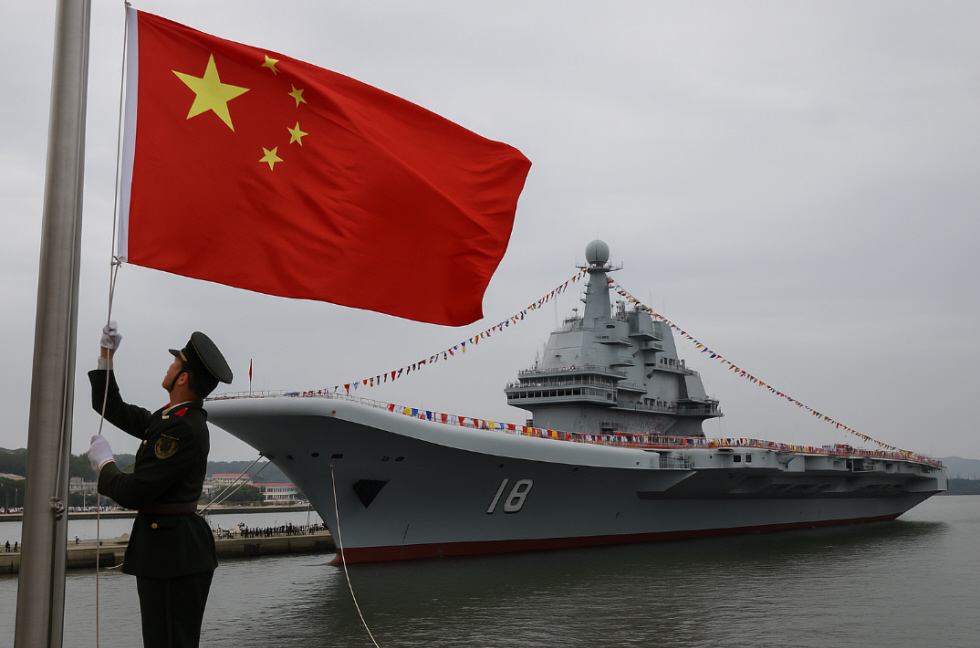
With military pomp and a grand ceremony, China has officially commissioned its third aircraft carrier, the Fujian, in the presence of President Xi Jinping. The event took place on Hainan Island before some 2,000 attendees, including naval officers and shipyard workers. The Fujian represents a major technological leap: it is the first aircraft carrier fully designed and built in China and equipped with an electromagnetic catapult system (EMALS)—a feature previously exclusive to the U.S. Navy’s USS Gerald Ford, the world’s most advanced warship of its kind.
Why it matters.
The commissioning of the Fujian strengthens Beijing’s ambition to project naval power far beyond its territorial waters amid rising tensions with the United States and its allies in the Pacific. The electromagnetic catapult allows fighter jets to launch with greater payloads and extended range, replacing the long-used steam catapult system. With this vessel, China expands its fleet to three aircraft carriers, alongside the Liaoning (2012) and the Shandong (2019), both of which are based on earlier Soviet or adapted designs—signaling a decisive move toward a fully domestically built navy.
What’s next.
Although still far from matching the U.S. Navy’s eleven-carrier fleet, the Fujian stands as a symbol of China’s rapid military modernization and its determination to become a global maritime power. The ship made headlines in September after crossing the politically sensitive Taiwan Strait during what officials described as “scientific tests and training missions.” Analysts suggest that its next phase will involve operational deployment on long-range missions, marking a new chapter in China’s naval strategy.


