
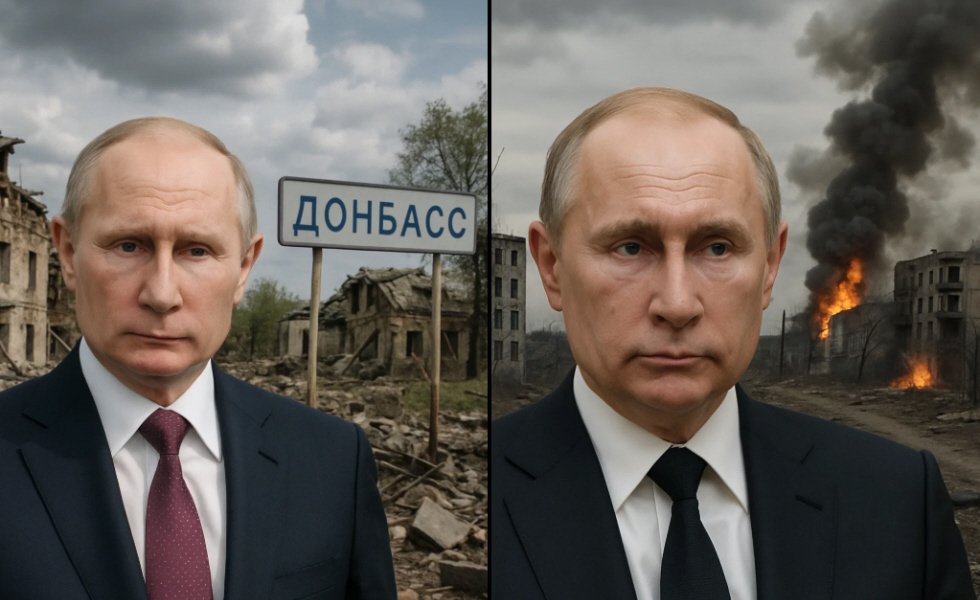
Russian President Vladimir Putin hardened his stance once again during the summit in Anchorage, Alaska, making it clear that any possibility of a ceasefire with Ukraine depends on the recognition of Russian sovereignty over the regions of Donetsk and Luhansk, located in the heart of the Donbas. According to sources close to the negotiations, Putin stated that without the formal cession of these territories, there would be no substantial progress in peace talks.
Moscow’s position, expressed directly in front of former U.S. President Donald Trump, raised concern among European allies, who warned that peace based on territorial concessions would be unacceptable. For Putin, however, control of Donetsk and Luhansk is the minimum requirement to freeze the conflict on other fronts such as Kherson and Zaporizhzhia, regions where heavy fighting continues.
This condition effectively legitimizes an annexation that has been rejected by the international community since 2014, when the war in eastern Ukraine began. Trump, who described the meeting as “productive,” appeared open to the idea that Kyiv “must negotiate” to avoid a prolonged war. His remarks sparked strong criticism in Europe and within the United States, where opponents and analysts argue that such rhetoric weakens Ukraine’s position and could pave the way for Moscow to gain diplomatic benefits without halting its offensive.
Ukrainian President Volodymyr Zelenskyy reacted strongly, flatly rejecting any territorial concessions and insisting that Ukraine’s integrity is non-negotiable. “We will not surrender Donetsk, Luhansk, or any other part of our territory,” he declared in a statement issued from Kyiv. Zelenskyy further emphasized that the only path to a genuine agreement is the complete withdrawal of Russian troops and respect for internationally recognized borders. Meanwhile, leaders in Brussels, Berlin, and Paris reiterated their commitment to providing military and financial support to Ukraine, assuring that the European Union will not accept agreements undermining the country’s sovereignty.
Moscow, on the other hand, celebrated the fact that its demands were presented at a high-profile summit on U.S. soil, interpreting it as implicit recognition of its negotiating power. The outlook after the summit reflects a complex scenario: while Russia seeks to consolidate its territorial gains by demanding maximalist conditions, Ukraine and its Western allies remain firm in defending territorial integrity. In this context, future negotiations appear difficult, and the risk of a prolonged conflict remains high.


