

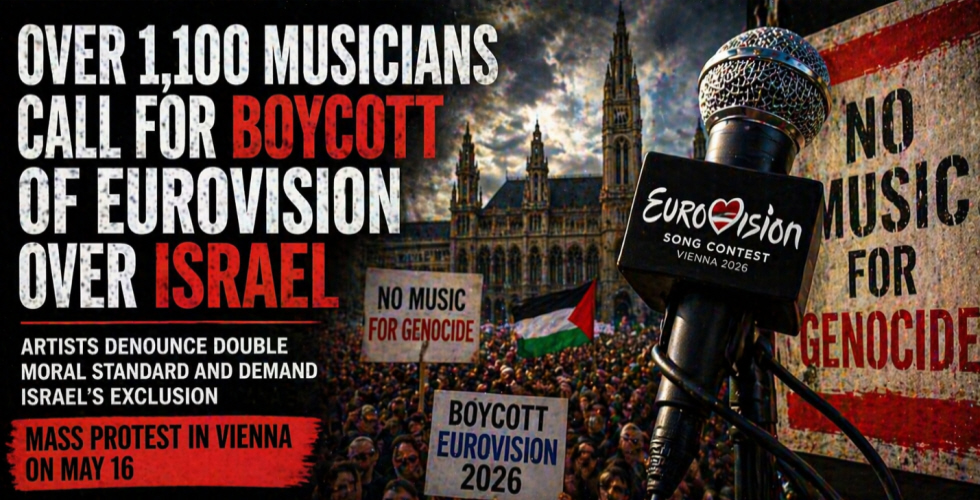
The growing controversy surrounding the 2026 Eurovision Song Contest 2026 has stopped being only a musical discussion and has become an international political debate. More than 1,100 musicians, composers, and cultural figures have signed an open letter calling for a boycott of the contest, which this year will be held in Vienna. The central reason is Israel’s participation in the competition. Music once again becomes the stage for a global dispute. Among the signatories are major names such as Brian Eno, Peter Gabriel, Massive Attack, and Sigur Rós, along with hundreds of independent artists and cultural workers.
The campaign has been driven by the movement “No Music For Genocide,” which demands a stronger position from the organizers. The pressure is no longer symbolic—it is public, organized, and growing. The main argument of the protesters focuses on what they describe as a “double moral standard” by the European Broadcasting Union. They point out that Russia was excluded from the contest after the invasion of Ukraine, while Israel continues to participate amid the war in Gaza and growing international concern over the humanitarian situation.
For critics, the difference in treatment reflects a political inconsistency that is difficult to justify. Cultural neutrality is once again being questioned. The artists are not only asking for symbolic reflection, but for concrete action. They demand that the Israeli public broadcaster KAN be suspended from the contest while the conflict continues and international accusations over human rights violations remain unresolved. From their perspective, allowing that participation represents indirect legitimization that contradicts the values of inclusion and peace that Eurovision often promotes.
The protest seeks to change the stage, not just comment on it. In addition to the open letter, a major demonstration has already been scheduled for May in Vienna, where thousands of people could gather during the days of the festival. The city is preparing not only for one of Europe’s largest televised events, but also for a large-scale cultural protest. The media impact could be enormous. Eurovision may become the center of a cultural diplomatic crisis. For now, the organizers maintain their official position that the festival should not become a space for selective political exclusion.
The EBU insists that it is a competition between public broadcasters, not governments, although that explanation no longer convinces much of the artistic community. The argument of neutrality weakens when war enters the stage. Culture rarely remains isolated from reality. Israel, for its part, defends its right to participate and rejects the idea that the festival should be used as a tool of political pressure.
Its representatives argue that music should serve as a bridge, not as a mechanism of international punishment. However, the current geopolitical climate makes it almost impossible to completely separate art from conflict. Every performance ends up being interpreted as a political message as well. Publishing this story in Culture is not only appropriate, but necessary.
This is not simply about a music festival, but about a debate over moral consistency, artistic freedom, and the role of international stages in the face of humanitarian crises. Eurovision has always been spectacle, but today it is also a mirror of global tensions. When artists speak, they are often saying far more than a song.


