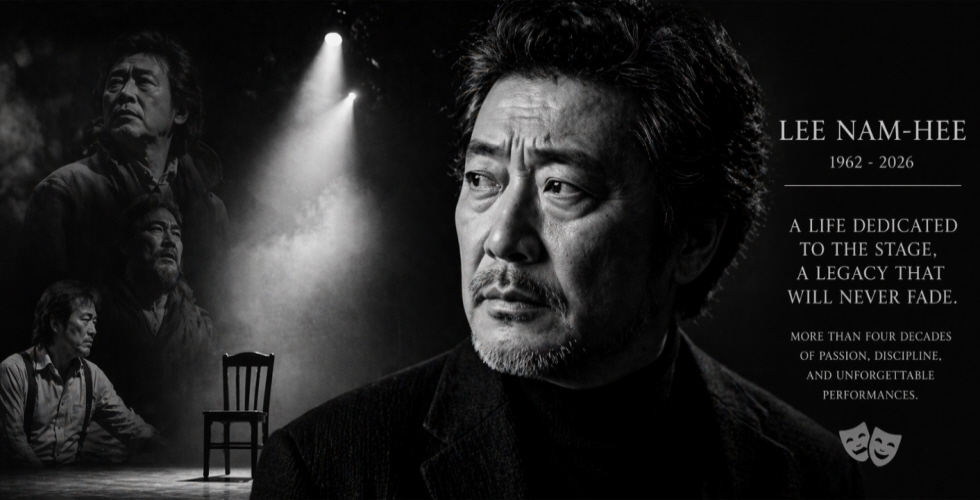
The death of Lee Nam-hee marks the end of a deeply respected career within South Korean theater. For more than four decades, his presence on stage represented discipline, talent, and absolute dedication to dramatic art. His passing at the age of 64 has created a strong sense of loss among colleagues, audiences, and generations of actors who grew up admiring his work. South Korea says goodbye to one of its strongest theatrical voices. Born in 1962, Lee began his artistic journey in an era when theater demanded rigorous training and genuine vocation. His debut in 1983 with Antigone marked the beginning of a career built with patience and interpretive depth.
From that moment, he became a constant name on some of the country’s most respected stages. He did not seek quick fame, but lasting artistic permanence. Over the years, he performed in major dramatic productions such as A Streetcar Named Desire, Othello, Urfaust, and Death of a Salesman. Each of these works required complex acting ability, something Lee mastered with natural elegance. His style was defined by restrained intensity, without exaggeration, always focused on the emotional truth of the character.
That consistency became one of his greatest strengths. Although his name was strongly connected to theater, he also left an important mark in film and television. He appeared in productions such as The Priests, Steel Rain 2, and the historical TV drama Six Flying Dragons, expanding his reach to new audiences. Even so, he never abandoned his theatrical essence. The stage always remained his true artistic home. His colleagues describe him as an actor of enormous discipline, committed to every rehearsal and deeply respectful of the profession. He was not the kind of artist who sought media attention, but the kind who built prestige through silent and constant work.
That way of living art gave him natural authority within the cultural world. His legacy goes far beyond applause. The news of his passing, after a long illness, has brought spontaneous tributes from the artistic community. Young actors, directors, and theater lovers have remembered not only his performances, but also his human and professional influence. In a time dominated by digital immediacy, figures like Lee represent another way of understanding culture.
One that is slower, deeper, and far more lasting. His departure also invites reflection on the value of theater as a space of memory and cultural resistance. While other forms of entertainment change rapidly, the stage preserves a direct relationship between actor and audience that few arts can offer. Lee Nam-hee defended that essence throughout his entire life. His work proved that theater remains necessary.
Beyond his physical absence, there remains a body of work built with patience, respect, and true passion. Lee Nam-hee was not simply a recognized actor, but a symbol of commitment to performing arts. His name will remain linked to a generation that understood acting as a vocation, not as spectacle. Culture loses an essential figure today, but his legacy will continue on every stage where his memory still resonates.