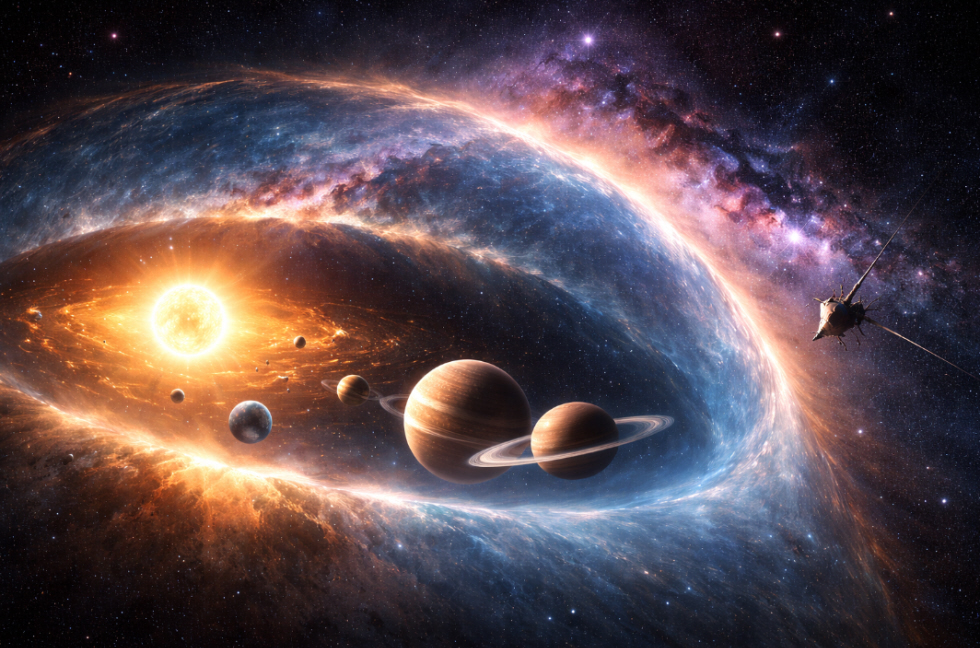
For decades, the Solar System was commonly portrayed as a nearly perfect bubble enclosing the Sun and its planets, separated from interstellar space by a clear boundary known as the heliopause. This simple image, repeated in textbooks, scientific diagrams, and popular culture, shaped a tidy and reassuring vision of our cosmic neighborhood. That picture, however, has been steadily challenged by the Voyager probes.
Launched in 1977 with far more limited expectations, these spacecraft have gradually become unintentional interstellar explorers, sending back data that suggest the heliosphere—the region dominated by the solar wind—is far more complex than once believed. Rather than forming a smooth, symmetrical sphere, the “bubble” surrounding the Solar System appears distorted, irregular, and constantly reshaped by external forces.
The interaction between the solar wind and the interstellar medium produces a dynamic structure influenced by magnetic fields, energetic particles, and motions that scientists are still working to fully understand. Measurements from the Voyager missions indicate that the heliopause is not a sharp or uniform boundary. In some regions, it behaves like a flexible barrier; in others, it resembles a diffuse zone where solar and interstellar particles mix in unpredictable ways.
This complexity challenges models that were long considered reliable. Beyond its scientific implications, this discovery carries cultural significance. It highlights how human representations of the cosmos often simplify a reality that is far more fluid and strange. The Solar System is not an isolated, orderly island, but a living structure constantly interacting with its galactic environment.
The Voyager probes themselves embody one of science’s great paradoxes: missions designed to last only a few years have ended up reshaping our understanding of space decades later. Their extraordinary technological longevity has made it possible to observe phenomena that cannot be studied from Earth. This evolving perspective also reinforces a fundamental lesson of science: knowledge is never static. Assumptions are revised, models are refined, and new questions emerge as observation advances.
What once seemed like a clear frontier now appears as a shifting and fascinating boundary. In this sense, the heliopause becomes more than an astronomical concept. It stands as a cultural symbol of the edge between the known and the unknown, reminding us that even our most familiar ideas can change when curiosity dares to travel a little farther.