
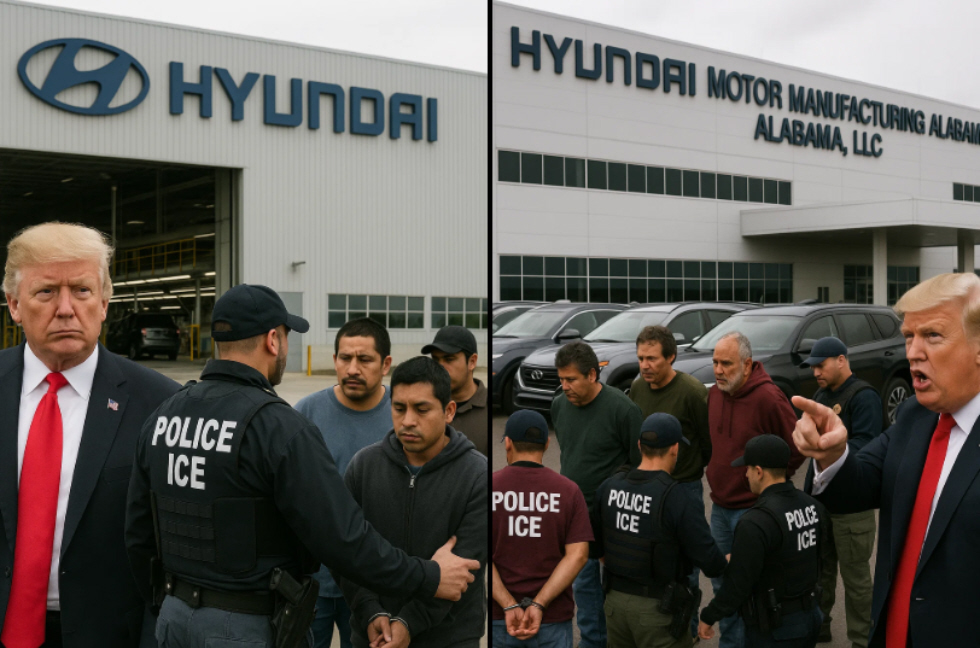
A week and a half after agents from the U.S. Immigration and Customs Enforcement (ICE) arrested 475 workers —most of them South Korean— at a battery plant under construction in the state of Georgia, U.S. President Donald Trump surprised many by declaring that he “welcomes them” and that the country “needs” their talent. The arrests, carried out at facilities operated by South Korean companies Hyundai and LG, had sparked strong protests in South Korea, one of Washington’s key allies in Asia.
In a message posted on his Truth Social platform, Trump stated that these highly skilled workers represent an opportunity for the U.S. industry to learn. “We welcome them, we welcome their employees, and we are ready to proudly say that we will learn from them and that, at some point in the not-too-distant future, we will even be better than them at their own ‘game,’” wrote the president.
Trump added that the United States needs skilled foreign workers to regain its ability to manufacture “extremely complex products” such as chips, semiconductors, computers, ships, and trains. “We have to learn from others to build them or, in many cases, we have to relearn because we used to be excellent at it, but we are not anymore,” he said, stressing that his intention is not to “scare or discourage foreign investments” in the country.
The president’s remarks contrast with the tougher tone he maintained during his election campaign, when he promised to deport millions of undocumented immigrants and tighten border controls. Since taking office, ICE has intensified raids in factories and workplaces, with masked agents carrying out mass arrests that have been heavily criticized by human rights organizations and allied governments.
Although the White House has not announced concrete measures to resolve the case of the detained South Korean workers, Trump’s shift in tone appears aimed at easing diplomatic tensions and sending a message of reassurance to foreign companies investing in the country, at a time when the U.S. is competing to attract capital and talent in strategic technology sectors.


