
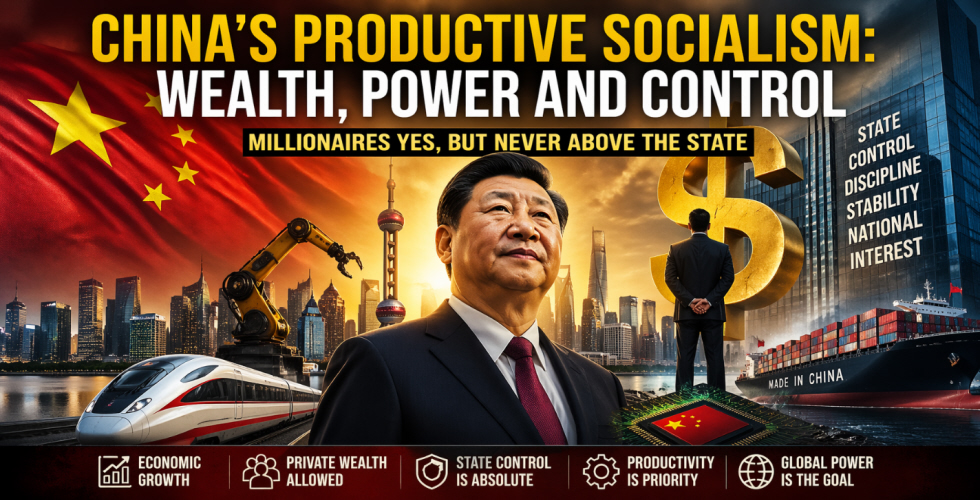
China has developed an economic and political model that many observers struggle to place within traditional categories. It is neither the classic communism of the former Soviet Union nor free-market capitalism in the Western sense. Its structure combines absolute state control with strong production capacity and economic expansion. For our analyst Williams Valverde, this model can be more accurately defined as productive socialism. In this system, the existence of millionaires is not seen as an ideological contradiction. On the contrary, private wealth is accepted as long as it contributes to strengthening the national project.
The goal is not to eliminate capital, but to subordinate it to the strategic interests of the state. Production and stability matter more than absolute equality. China allows the existence of major entrepreneurs, giant corporations and foreign investment, but under strict political supervision. The Communist Party maintains final control over the country’s most important decisions. There is no real separation between the economy and political power. The market functions, but always within limits defined by the state. The main difference with the West lies in who controls whom.
In many Western democracies, private capital strongly influences politics and public decisions. In China, the opposite happens: politics disciplines capital and defines how far it can go. An entrepreneur may grow rich, but never beyond the reach of central power. The case of Jack Ma became one of the clearest examples of this logic. As the founder of Alibaba, he represented the success of China’s private sector and the rise of a new business elite. However, when his public comments were interpreted as a challenge to the system, he disappeared from the center of public life.
The message was clear: money does not rule the Party. This model does not seek an equal society in the classic sense, but rather a functional and productive one. The priority is not for everyone to have the same, but for everyone to be useful to national development. Individual wealth is tolerated if it strengthens overall stability. The state rewards productivity, but punishes excessive political independence. That is why some describe it as supervised capitalism, while others prefer the term productive socialism. The central idea is that economic growth should not weaken state authority, but reinforce it. Wealth becomes a tool of national power.
It is not about total economic freedom, but about controlled efficiency. China has also shown that this model can compete on a global scale. Its technological, industrial and commercial expansion has transformed the international economic balance. From infrastructure to artificial intelligence, Beijing acts with a long-term strategic vision. Growth is not improvised, but part of a structural national project. In geopolitical terms, this combination of internal discipline and external ambition has allowed China to challenge the traditional leadership of the United States.
China is not only competing for markets, but also for political, technological and financial influence. Its model is not presented as an ideology to export, but as a demonstration of effectiveness. That makes it even more powerful. Many countries observe this system with a mixture of admiration and concern. Some see it as an alternative to Western liberalism; others view it as a threat to individual freedoms. What is certain is that China has built its own formula, difficult to copy but impossible to ignore.
Its weight is redefining the twenty-first century. The great question is whether this model can be sustained in the long term without creating deep internal fractures. Absolute control requires constant stability, and economic growth does not always guarantee permanent political legitimacy. The relationship between prosperity and obedience will be one of the most important tests for China’s future.
That is where the real tension lies. For now, China does not appear to defend traditional communism, but rather a modern form of organized power. It is a system where you can be a millionaire, but never more powerful than the state. That is the essence of what Williams Valverde defines as productive socialism. And perhaps it is also one of the keys to understanding the new world order.
BY:
Williams Valverde


